
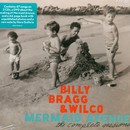
Mermaid Avenue: The Complete Sessions (CD3 + DVD)
Billy Bragg & WilcoCD1 MERMAID AVENUE
- Walt Whitman's Niece
- California Stars
- Way Over Yonder in the Minor Key
- Birds and Ships
- Hoodoo Voodoo
- She Came Along to Me
- At My Window Sad and Lonely
- Ingrid Bergman
- Christ for President
- I Guess I Planted
- One by One
- Eisler on the Go
- Hesitating Beauty
- Another Man's Done Gone
- The Unwelcome Guest
CD2 MERMAID AVENUE VOL. II
- Airline to Heaven
- My Flying Saucer
- Feed of Man
- Hot Rod Hotel
- I Was Born
- Secret of the Sea
- Stetson Kennedy
- Remember the Mountain Bed
- Blood of the Lamb
- Aginst th' Law
- All You Fascists
- Joe DiMaggio Done It Again
- Meanest Man
- Black Wind Blowing
- Someday Some Morning Sometime
CD3 MERMAID AVENUE VOL. III
- Bugeye Jim
- When the Roses Bloom Again
- Gotta Work
- My Thirty Thousand
- Ought to Be Satisfied Now
- Listening to the Wind That Blows
- Go Down to the Water
- Chain of Broken Hearts
- Jailcell Blues
- Don't You Marry
- Give Me a Nail
- The Jolly Banker
- Union Prayer
- Be Kind to the Boy on the Road
- Ain'ta Gonna Grieve
- Tea Bag Blues
- I'm Out to Get
DVD
- Man in the Sand - Documentary about making of Mermaid Avenue
In celebration of the centennial year of Woody Guthrie’s birth, Nonesuch Records releases Mermaid Avenue: The Complete Sessions, on Record Store Day (April 21). When American folk legend Woody Guthrie died in 1967 at the age of 55, he left behind a trove of more than one thousand sets of complete lyrics with no music. In 1995, his daughter Nora approached English singer-songwriter and activist Billy Bragg and about the possibility of bringing these unheard songs to life by
setting them to new music. Wilco came aboard soon after, and in 1998 Mermaid Avenue was released to critical acclaim, receiving a Grammy nomination for Best Contemporary Folk Album. Mermaid Avenue, Vol. II followed in 2000, and together the two have sold close to one million copies to date.
When American folk legend Woody Guthrie died in 1967, at the age of 55, among his stored belongings were thousands of complete song lyrics for which he had not written out music or made recordings. Many of them had been written in the 1940s and ’50s, in the Guthrie family home on Mermaid Avenue in Coney Island, Brooklyn. The lyrics remained in boxes for decades, but once his daughter Nora found them in the 1990s, she knew they had to be shared. She approached English singer-songwriter and
activist Billy Bragg to select some to set to music. The Chicago rock band Wilco came aboard soon after, with Jeff Tweedy writing music—along with his late bandmate Jay Bennett on some songs—and the band recording with both Tweedy and Bragg on vocals. Natalie Merchant joined the group to sing a duet with Bragg and two solo songs, and guitarist/singer Corey Harris, who wrote two songs and co-wrote one, performed on many tracks. In 1998, the first batch of songs was released to critical acclaim
as Mermaid Avenue, receiving a Grammy nomination for Best Contemporary Folk Album. Mermaid Avenue Vol. II followed in 2000.
In her liner note, Nora Guthrie describes her response to finding these lyrics, which were much more personal and journal-esque than the earlier works for which Woody was best known: “I had just discovered that my father had written more song lyrics than any of us could ever imagine. (Over 3,000 when I finally did the count.) I had just discovered that he had a bad crush on Ingrid Bergman and dreamed of getting her pregnant, that he felt sorry for Hans Eisler, that he was a proud lush and a
comfortable luster, that he believed in flying saucers, that he was homesick for California, that he even knew who Joe DiMaggio was let alone wrote a song about him, or that he once made out with a girl in a tree hollow when, as a kid, he bragged, ‘There ain’t nobody that can sing like me.’”
The New York Times said of the first volume, “[Tweedy and Bragg] are the perfect pair to conclude that Guthrie, far from a predictable Popular Front totem, was a prophetic rock-and-roller with a whole lot to say. All he needed was a band and a little freedom…It says a great deal for [Bragg] that he recognized that his leftism only half-equipped him to bring it off. Woody Guthrie was as American as it gets, and [Chicago–based] Wilco provided that element as few other contemporaries could have.
Wilco’s signature, a spacious stylistic sweep from blues to bluegrass, brings all this music to a life no…Brits or Nashville pros could have approached.”
Bragg told NPR in 1998, “The words are so powerful, they’re so evocative to many people…That’s the strength of Woody, it’s the simplicity.” Tweedy added, “I’d have a really good feeling about things if [the album] did lead a certain number of people back to discover Woody Guthrie.”