
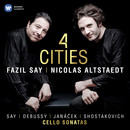
4 Cities
Nicolas Alstaedt, Fazil Say- Fazil Say: Four Cities, sonata for violoncello and piano: I – Sivas
- Fazil Say: Four Cities, sonata for violoncello and piano: II – Hopa
- Fazil Say: Four Cities, sonata for violoncello and piano: III – Ankara
- Fazil Say: Four Cities, sonata for violoncello and piano: IV – Bodrum
- Claude Debussy: Sonata for violoncello and piano: Prologue
- Claude Debussy: Sonata for violoncello and piano: Sérénade
- Claude Debussy: Sonata for violoncello and piano: Final
- Leos Janacek: Works for violoncello and piano: Pohadka (A Tale): I Con moto
- Leos Janacek: Works for violoncello and piano: Pohadka (A Tale): II Con moto
- Leos Janacek: Works for violoncello and piano: Pohadka (A Tale): III Allegro
- Leos Janacek: Works for violoncello and piano: Pohadka (A Tale): Presto
- Dimitri Shostakovich: sonata for violoncello and piano op.40: I Allegro non troppo
- Dimitri Shostakovich: sonata for violoncello and piano op.40: II Allegro
- Dimitri Shostakovich: sonata for violoncello and piano op.40: III Largo
- Dimitri Shostakovich: sonata for violoncello and piano op.40: IV Allegro
This imaginative and captivating programme of works for cello and piano brings the Warner Classics debut of French-German cellist Nicolas Altstaedt – a much-admired performer and already an established recording artist. He frequently collaborates with leading younger composers and here he is partnered by Fazıl Say, the Turkish-born pianist and composer who signed a new Warner Classics contract last summer, having been associated with the label for some 20 years. Recorded in the celebrated Mozarteum in Salzburg, this recital offers an intriguing combination of repertoire from the 20th and 21st centuries: by Fazıl Say himself and by Debussy, Janáček and Shostakovich.
The work by Say is Four Cities (Dört Şehir), a programmatic sonata commissioned by the BBC and premiered by Nicolas Altstaedt with the pianist José Gallardo in London in 2012. The four cities it portrays – through a kaleidoscope of melodies, rhythms, cultural references and instrumental colouration – are all in Turkey and all very different: Sivas, Hopa, Ankara and Bodrum. Sivas, in the eastern-central region of the country, was one of the first places where Say performed as a student; Hopa is on the Black Sea, on the border with Georgia; Ankara, Turkey’s capital, was Say’s birthplace, and Bodrum is the country’s most glamorous and cosmopolitan resort, located on the Aegean Sea. At times in Four Cities, Altstaedt uses his cello to evoke traditional Turkish instruments like the saz or bağlama, a kind of lute, and the bowed kemençe. In addition to embracing folk music, the score – whose moods range from rumbustious celebration to wistful nostalgia – references popular song and, in ‘Bodrum’, jazz and rock, reflecting Say’s fascination with mixing cultures and genres.
As Gramophone has written: “…Say emerges as a searcher and a seeker, someone who dares to be different and is not afraid to step outside the concert pianist box to compose, improvise and experiment. We need more like him.” Say himself has explained that he is “a classical pianist and Western composer who is interested in jazz and world music … It's not the imitating of these [traditional] instruments that is important, but imitating their emotions … I would never copy a folk melody exactly, but always make an abstraction of it that fits with me emotionally.” He summed up his existential and artistic philosophy in an interview with the Frankfurter Rundschau: “More and more, time and again, I find that my home lies in music. That’s where I feel in the right universe. You know, I’ve always thought that a city belongs to a country, that a country belongs to the world, that the world is a planet which belongs to the solar system, and that the solar system belongs to the Milky Way and to the universe. Everything belongs to everything else.
Like Four Cities, many of Debussy’s scores intoxicate with their colours and imagery, but his Cello Sonata is one of the more austere works he wrote towards the end of his life, when he was terminally ill and disillusioned by the First World War. That being said, it is a characteristically subtle, sometimes mercurial piece, associated in the composer’s mind with the romantic figure of the moonstruck Pierrot. Janáček’s four-movement Pohádka (complemented here by the separate Presto that forms an ‘unofficial’ element of the work) offers a fairy-tale narrative, since it draws on the epic poem by the Russian poet Vasily Zhukovsky that also inspired Stravinsky's Firebird. The definitive version of Pohádka dates from 1923, and Shostakovich’s cello sonata was first heard just 11 years later. It too has a story behind it: the composer’s anxiety at his trial separation from his wife, Nina. Like Debussy’s sonata, it is characterised by both neoclassical restraint and elements of sardonic humour.