
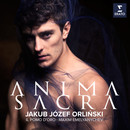
Anima Sacra
Jakub Jósef Orliński- Fago (1677-1745) : Alla gente a Dio diletta – from Il Faraone sommerso
- Fago : Confitebor tibi Domine : Confitebor tibi Domine
- Fago : Confitebor tibi Domine : Memoriam fecit mirabilium suorum
- Fago : Confitebor tibi Domine : Fidelia omnia mandata ejus
- Fago : Confitebor tibi Domine : Sanctus et terribile
- Fago : Confitebor tibi Domine : Initium sapentiae timor Domini
- Fago : Confitebor tibi Domine : Intellectus bonus omnibus - Gloria
- Fago : Confitebor tibi Domine : Sicut erat in principio - Amen
- Heinichen : Alma Redemptoris Mater : Aria: "Alma Redemptoris Mater"
- Heinichen : Alma Redemptoris Mater : Accompagnato: "Tu quae genuisti"
- Heinichen : Alma Redemptoris Mater : Aria: "Gabrielis ab ore"
- Teradellas : Donec ponam – Aria for contralto from Dixit Dominus :
- Fago : Tam non splendet sol creatus :Aria: "Tam non splendet sol creatus"
- Fago : Tam non splendet sol creatus : Recitativo: "O nox clara?"
- Fago : Tam non splendet sol creatus : Aria: "Dum infans iam dormit"
- Fago : Tam non splendet sol creatus : "Alleluia"
- Sarro : Laudamus te - aria for contralto from Messa a 5 voci in Fa maggiore :
- Feo : Juste Judex ultionis - from Dies Irae in G
- Zelenka : Smanie di dolci affetti...S'una sol lagrima from Gesù al Calvario - ZWV 62 : Accompagnato - "Smanie di dolci affetti..."
- Zelenka : Smanie di dolci affetti...S'una sol lagrima from Gesù al Calvario - ZWV 62 : Aria - "S'una sol lagrima"
- Hasse : Mea tormenta, properate! - from Sanctus Petrus et Sancta Maria Magdalena
- Schiassi : L'agnelletta timidetta - from Maria vergine al Calvario
- Durante : Domine Fili Unigenite - Aria for contralto from Messa a 5 voci
This release, Anima sacra, marks a number of firsts. It is the debut album from countertenor Jakub Józef Orliński – born in Poland, trained at the renowned Juilliard School in New York and winner in 2016 of the Metropolitan Opera's prestigious National Council Auditions. It also features what are believed to be world premiere recordings of eight Baroque arias, notably by composers of the Neapolitan school.
“Baroque style is about freedom and passion,” says Orliński. “There are lots of rules of style to follow, but there are also so many choices to make, starting with ornamentation that you can do in so many different ways. With those ornaments, you can show your creativity, but also get even deeper into the piece and show your artistic persona. It can all be filtered by your own life experiences, which will inspire your choices.”
Warsaw-born Orliński, who has been praised by the New York Times for combining “beauty of tone and an uncommon unity of colour and polish across his range”, comes from a family in which, as he says, “almost everyone is a painter, architect, graphic designer or sculptor”. He began singing in choirs and became a particular fan of the British male vocal ensemble The King’s Singers, which, significantly, has always featured two countertenors. Before completing his studies at Juilliard, he took a Master’s degree in Vocal Performance at Warsaw’s Fryderyk Chopin University of Music and became a member of the young artists’ programme of the Polish National Opera.
He describes his younger self as “one of those kids who always have listened to music, danced around to it and have had it on headphones during travels. That is why from an early age I had many dreams about recording music. It was a great motivation kick, along with the admiration I have for so many great recording artists, their skills and musicianship, the quality of sound and their ideas for albums. I always wanted to join them, create something special like they did: something that is not yet out there; something which would make my first, dream album a little bit different than the others.’
Anima sacra asserts its individuality with a tempting line-up of rarities. The album places a particular emphasis on composers of the influential Neapolitan school: Nicola Fago, Francesco Durante, Francesco Feo, Domenico Sarro and Domingo Terradellas. There are also arias by Gaetano Schiassi, active in Bologna and Lisbon, and by the Czech-born Jan Dismas Zelenka and the Germans Johann Hasse and Johann Heinichen. (The numbers by these last three composers have been recorded previously by other performers.)
Orliński is partnered on the album by Il pomo d’oro conducted by Maxim Emelyanychev. This brilliant ensemble has already made a number of recordings for Erato, working with such artists as singers Joyce DiDonato, Philippe Jaroussky, Max Emanuel Cenčić and Emőke Baráth, and cellist Edgar Moreau.
When Orliński sang at New York’s Alice Tully Hall in 2016 – while still a Juilliard School student – the critic Matthew Gurewitsch wrote that “the deluxe quality of his instrument shone forth from his first attack, the timbre flaring with dusky brilliance at the top, shading smoothly to feral colorations below. His agility put him in a class with the masters.”
Since then Orliński has appeared in the US at Carnegie Hall and with the Houston Symphony, and in Europe at the Barbican and Wigmore Hall in London, the Frankfurt Opera, the Karlsruhe Handel Festival and the Aix-en-Provence Festival.
While in Provence last summer he made an appearance on the radio station France Musique, singing the Vivaldi aria ‘Vedrò con mio diletto’, taken from the opera Giustino. A video of his performance was also placed on Facebook. It went viral on the internet and has since achieved a total of over two million views. Beyond the beauty of the aria and Orliński’s singing, the video has attracted attention because he and his pianist, Alphonse Cemin, defy visual expectations of classical performers: they were only expecting to appear in a radio broadcast and had turned up in shorts and casual shirts.
For all the credentials he has gained as a countertenor, Orliński also surprises by being a virtuoso in another field: breakdancing. “It is something which combines physicality with creativity,” he says. “It gives you so much freedom. It’s art. I wouldn’t be in that place right now without breakdancing. Over the years I have learnt so much about myself, just through dance and the travels that have been connected to it. I have met so many people who helped me one way or another. Breakdancing also has a huge impact on my artistic life as a singer.”