
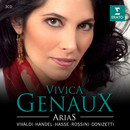
Arias
Vivica GenauxCD1
- La Cenerentola: Nacqui all'affanno
- L`Italiana in Algeri: Cruda sorte! Amor tiranno
- L`Italiana in Algeri: Pensa alla patria
- Lucrezia Borgia: Nella fatal di Rimini
- Lucrezia Borgia: Il Segreto per esser felici
- Alahor in Granada: Popolo, amici, sanguinosi allori...Ah si, da tanti affani
- Anna Bolena: E sgombro il loco...Un bacio ancora
- La Donna del lago, '(The) Lady of the Lake': Mura felici
- Semiramide: In si barbara sciagura...Ah Quel giorno ognor rammento
- Il Barbiere di Siviglia: Una voce poco fa
CD2
- Orlando HWV31: Aria: "Fammi combattere mosti e tifei"
- Orlando HWV31: Aria: "Ah! Stigie larvae"
- Alcina HWV 34: Aria: "Sta nell'Ircana pietrosa tana"
- Splenda l'alba in oriente, cantata HWV 166: Aria: Splenda l'alba in oriente
- Splenda l'alba in oriente, cantata HWV 166: Recitativo: Tu, armonica Cecilia
- Splenda l'alba in oriente, cantata HWV 166: Aria:La virtute è un vero nume
- Arminio: Aria: "Ti laschio in ceppi avvinto"
- Arminio: Aria: "Se mia speranza"
- Arminio: Aria: "Vaghi rai, pupille amate"
- La Scusa: Recitativo: No, perdonami, o Clori
- La Scusa: Aria: Trova un sol
- La Scusa: Recitativo: Placati o pastorella
- La Scusa: Aria: Torna in quel onda chiara
CD3
- Catone in Utica: Come in vano il mare irato
- Semiramide: E prigioniero e re
- La fida ninfa: Alma oppressa
- Griselda: Agitata da due venti
- La fida ninfa: Destin nemico....Destin avaro
- Il labbro ti lusinga
- Ipermestra: Vibro il ferro
- Farnace: No, ch'amar non è fallo in cor guerriero....Quell'usignolo
- Tito Manlio: Splender fra 'l cieco orror
- Rosmira fedele: Vorrei dirti il mio dolore x
- Catone in Utica: Chi può nelle sventure....Nella foresta
- Farnace: Ricordati che sei
- Sin nel placido soggiorno
Mezzo-soprano VIVICA GENAUX, lauded as one of the pre-eminent interpreters of Baroque and bel canto music, continually earns accolades for the beauty of her voice and the astounding brilliance of her technique. She has performed at the world’s leading music capitals, from New York to London, Paris, Berlin, Vienna, Milan, Moscow and Tokyo.
As with each season, during 2015-2016 she portrays a wide array of characters, appears in concerts and recitals as well as operas and sings throughout Europe, in the United States and the Far East.
She returns to Washington Concert Opera as Arsace in Semiramide and offers a series Baroque arias by Porpora and Broschi in Paris with Les Musiciens du Louvre at the Salle Gaveau.
Last season she added three roles to her repertory: Ruggiero in Händel’s Alcina (Moscow), Farnaspe in Veracini’s Adriano in Siria, (Valencia & Madrid) and the title role in Cavalli’s Veremonda (Spoleto/USA), bringing her total number of roles to fifty-nine, of which thirty-nine are en travesti. She also performed Romeo in I Capuleti ed I Montecchi (Rieti), the title role in Giulio Cesare (Shanghai), and Epitide in L’oracolo in Messenia (London & Yokohama). With soprano Simone Kermes and Cappella Gabetta she performed “Rivalries,” a program inspired by the fierce but fruitful competitiveness between Baroque divas Faustina Bordoni and Francesca Cuzzoni, with performances in Rheinfelden, Halle, Hamburg, Baden-Baden, Budapest, Landau, Luxembourg, Olten, Lucerne, Vienna, Paris, and Ludwigsburg. Ms. Genaux offered further homages to great singers: to the castrato Farinelli with Les Musiciens du Louvre (Grenoble) and to Pauline Viardot and Teresa Berganza (Madrid). She sang Vivaldi concerts with Fabio Biondi and Europa Galante (Rieti, Birmingham, Tokyo & Matsumoto); additional Vivaldi sacred music with the Bach Consort Wien in the Stefansdom (Vienna); the world premiere of Piet Swerts’ Le sac de Louvain and the Mozart Requiem in Leuwen, Belgium; Baroque concerts with Concerto Köln (Bücken & Vechta, Germany) and with her own period instrument group, V/Vox Ensemble (Venice).
This 3-CD box unites three recitals that showcase the virtuosity, elegance and expressivity of mezzo-soprano Vivica Genaux. Together, the programmes, recorded between 2003 and 2009, offer a survey of the repertoire that has figured most strongly in Genaux’s career – music from the 18th and early 19th centuries by Vivaldi, Handel, Hasse, Rossini and Donizetti. The spectacular recital of arias by Vivaldi, ‘Pyrotechnics’ was nominated for a Grammy Award in 2010.
The excitement that Genaux generates was expressed by Time Out New York in its review of the disc of arias by Rossini (the composer who launched her career) and Donizetti: “Genaux might be the most exciting singer in the world. Sinewy but lithe, her voice encompasses a wine-rich chest register, juiced up with just enough testosterone to keep things interesting, as well as luminous high notes that would do many a soprano proud. Her Italian is crisp and peppery, and she rips through pages of runs and embellishments with jaw-dropping ease.”
Vivica Genaux was born in Alaska and studied singing at the famous music school of Indiana University Bloomington, where her teachers were the celebrated husband-and-wife team of soprano Virginia Zeani and bass Nicola Rossi-Lemeni, She continued her vocal studies with Claudia Pinza, daughter of the legendary bass Ezio Pinza.
Since her professional debut in 1994, she has established herself as a thrilling exponent of music of the Baroque, Classical and bel canto eras. As the Chicago Tribune wrote in 2014: “The Alaska-born mezzo is among a handful of contemporary singers who can tackle this forgotten, hugely demanding repertory [virtuoso arias written for the famous castrati of the Baroque era] without flinching …The dark beauty and focus of her sound, combined with her uncanny facility and accuracy she brought to the most ornate coloratura passages, were impressive indeed.”
Opera News’s response to her CD recital of Handel and Hasse was: “Something special happens when she starts to sing – something that sets off a thrill, something that her warm, vibrant tone, razor-sharp diction, boldness of attack and sensational technique only begin to explain. Genaux has...pizzazz? Élan? Decide for yourself.”
Having started her stage career in Rossini, Genaux made the transition into Baroque repertoire with Handel’s Ariodante, but she has become a particular champion of the music of Johann Adolph Hasse (1699-1783). As she told Opera magazine in 2009: “Hasse for me is like a vocal day spa. It feels so good to sing.” The Hasse items on the second CD in this box prompted Gramophone to say that “Three well-crafted arias from Hasse’s Arminio are ideal fare for Genaux’s pinpoint accuracy and florid ornamentation, and his cantata La Scusa is the most enjoyable revelation (its 10-minute aria ‘Trova un sol’ has ravishing use of flutes and horns).”
The Vivaldi disc includes a number of premiere recordings of arias and runs a broad gamut of dramatic situations and emotions. When she recorded ‘Pyrotechnics’, Genaux explained that: “In Baroque music, what I really like is the interaction between the voice and the orchestra. The orchestra doesn’t just accompany but punctuates what you are saying as a singer, so you have the opportunity of really working closely with the instrumentalists. There are plenty of pyrotechnics in this recital, but in the sense of using ornamentation to amplify the emotion – so there is rapid coloratura and more delicate ornamentation too.” The album is overflowing with spectacular vocalism. As Opera magazine observed: “... The disc’s title, ‘Pyrotechnics’ is fully justified by the first track alone, ‘Come in vano ill mare irato’ (Catone in Utica), an aria fraught with coloratura gymnastics, dazzlingly executed. ...Creamy-voiced, intepretively insightful and – of course – pyrotechnically sensational ...”