
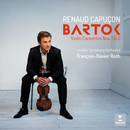
Bartók: Violin Concertos Nos. 1 & 2
Renaud Capuçon, London Symphony Orchestra, François-Xavier RothLPA
- Violin Concerto No.1, Sz. 36, BB 48a (1907 – 1908) - Andante sostenuto
- Violin Concerto No.1, Sz. 36, BB 48a (1907 – 1908) - Allegro giocoso
LPB
- Violin Concerto No.2, Sz 112, BB 117 (1937 – 1938) - Allegro non troppo
- Violin Concerto No.2, Sz 112, BB 117 (1937 – 1938) - Andante tranquillo
- Violin Concerto No.2, Sz 112, BB 117 (1937 – 1938) - Allegro molto
Renaud Capuçon’s concerto discography extends from JS Bach to composers of the present day. Until now, the concertos of Berg and Korngold have represented the first half of the 20th century, but with this release they are joined by Bartók’s two forays into the genre.
As François-Xavier Roth, the conductor of this recording says: “These two works are separated by almost 30 years and came about under vastly different circumstances. Beyond the fact that they are both concertos for solo violin and orchestra by Bartók, there is no reason to make direct comparisons between them.”
The Violin Concerto No 1 was written in 1907-8, when Bartók was in his twenties, and is an outpouring of (unreciprocated) love for a young violinist called Stefi Geyer, whom he set out to portray in the work. He had recently discovered the music of Debussy and Strauss and was in the early days of his exploration of folk music with his friend and compatriot Zoltan Kodály. Bartók wrote the concerto for Geyer to perform, and sent her the manuscript at her request, but it remained forgotten and unpublished until its received its premiere in 1958, two years after Geyer’s death and 13 years after Bartók’s.
“We can feel and hear that he wanted to write this work for a woman he was passionately in love with,” says François-Xavier Roth. “The language of the music is youthful, with beautiful writing for violin and an orchestra that is like a resonant instrument. The second movement, in particular, is virtuosic, joyful and pulsing.”
Nearly three decades later, in 1936, Bartók started composing his second violin concerto. Its premiere was given in Amsterdam in 1939 by Zoltan Székely, leader of the Hungarian Quartet and the Concertgebouw Orchestra. When writing the work – which dates from the same period as Music for Strings, Percussion and Celesta and the Sonata for Two Pianos and Percussion – Bartók studied the scores of recent violin concertos by such composers as Berg, Szymanowski and Weill. The following year he left war-torn Europe for the USA, where he died of leukaemia shortly after the end of World War II.
“The Second Concerto is clearly the work of a more mature and sophisticated composer,” says Roth. “It is a longer, much more developed piece and the writing for orchestra is very complex as it engages in a striking dialogue with the soloist, full of contrasts. The work starts with a simple serenade as the violin sings over harp, bass and cello, but in the finale the orchestra is like a monster that is pitted against the soloist.”
Capuçon and Roth have known each other for years, but this recording marks the first time they have collaborated simultaneously with the London Symphony Orchestra, of which Roth has been Principal Guest Conductor since the beginning of the 2017-18 season. “It was a privilege to be part of this recording,” he says. “Renaud is one of today’s greatest violinists and the recording sessions were demanding, but joyful.”
In late 2017, Capuçon performed Bartók’s Violin Concerto No 2 in Berlin with Roth conducting the city’s Staatskapelle. The Berliner Morgenpost wrote that “Capuçon adopted an approach to sound which, while rooted in the Romanticism of the 19th century, was at the same time imbued with Classical clarity … The Staatskapelle sounded light, transparent and brilliant, not carrying an ounce of extra Romantic fat. Roth cultivated a close rapport with the soloist and set fleet tempi. He brought an edge to the strings and the brass and coherently located Bartók’s miraculous variations [in the second movement] somewhere between Austrian Expressionism and French Neoclassicism. With Capuçon equally coherently sustaining his Romantic tone, both orchestra and soloist asserted their distinctiveness while also complementing each other. Thanks to Roth, Bartók’s score never sounded too Romantic, while thanks to Capuçon it never sounded too modern.”