
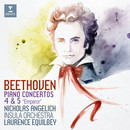
Beethoven: Piano Concertos 4 & 5
Nicholas Angelich, Insula Orchestra, Laurence Equilbey- Piano concerto No. 4 in G Major op. 58: Allegro moderato
- Piano concerto No. 4 in G Major op. 58: Andante con moto
- Piano concerto No. 4 in G Major op. 58: Rondo (Vivace)
- Piano concerto No. 5 in E-flat Major op. 73 "Emperor": Allegro
- Piano concerto No. 5 in E-flat Major op. 73 "Emperor": Adagio un poco mosso
- Piano concerto No. 5 in E-flat Major op. 73 "Emperor": Rondo. Allegro ma non troppo
The American-born, French-trained pianist Nicholas Angelich has, in the words of The Daily Telegraph, “the titanic technique that has to be the first port of call in tackling music of … magnitude and power...” It might therefore be a surprise to find him recording Beethoven’s Piano Concertos Nos 4 and 5 with an orchestra which, as the Financial Times wrote, “showcases the best in period-instrument performance.” The ensemble in question is the Insula Orchestra, conducted by its founder, Laurence Equilbey, and in 2016/17 concert audiences were lucky enough to hear this line-up perform the concertos at the Paris Philharmonie, the Seine Musicale (where Insula and Equilbey are resident artists) and in Aix-en-Provence.
Laurence Equilbey explains the thinking behind their interpretation and their choice of instrument, a lovingly restored concert grand built by the French company Pleyel in 1892, 65 years after Beethoven’s death.
“I see this recording as offering something new, precisely because of the compromise we have chosen to make with the piano – respecting the musical text, and the sonorities and spirit of Beethoven’s own time, whilst also seeking the kind of atmosphere and amplitude that speak to us today. All that was very important to us as we were making this recording…the poetry, the fusion of timbres, the overall dramatic energy, the radiance, and the sometimes improvisational style that is at the heart of the pianistic aesthetic of these two concertos. We tried to make everything emerge with natural vitality.
“The 1892 Pleyel is one of the first modern pianos and its sonorities evoke the same kind of poetry as a fortepiano. There is an exceptional symbiosis between this piano and the period instruments of the orchestra, which at times blend with it entirely, creating the impression of a unified whole … I love the crystalline quality that it has in the upper register and its liveliness at forte, and all its sonorities serve Beethoven’s musical language.
“Quite a number of ‘modern’ pianists have ventured into the field of period instruments. The reason for this is perhaps that the interface between the player and the instrument has remained the same – in other words, the keyboard. The pianist obviously has to adapt his or her touch, to manage the relationship between the keys and the pedals and to find an instrument that suits his or her expressive aims … but things are very different for, say, wind players, since their interface with the instrument has changed substantially over the past 200 years.
“The pianos and fortepianos of the 19th century open the way to the rediscovery of a range of sonorities that was lost in the 20th century through developments in the way instruments were built, in particular with a view to equalising registers and projecting sound. The Pleyel we use here seems to strike a happy medium between the kind of instrument created by Conrad Graf in the first half of the 19th century – which works beautifully for microphones, but less well in today’s large concert halls – and a modern Steinway, which seems very far away from the soundworld Beethoven knew.”
The album was recorded live at concerts at the Seine Musicale, the new arts complex on the outskirts of Paris. Beethoven was among the composers who, in April 2017, featured in the opening weekend of concerts given by Equilbey and the Insula Orchestra, founded in 2012. “The Insula Orchestra’s artistic values are excellence, innovation and openness, and these all fit perfectly with La Seine Musicale, which is is bathed in light, pure in its style and open to the world. I can look back on our first year of residency and honestly say it has been a success.”