
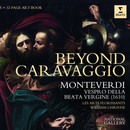
Beyond Caravaggio - Monteverdi: Vespro Della Beata Vergine
William Christie, Les Arts FlorissantsCD1
- Monteverdi: Intonatio: Deus in adiutorium - Domine ad adiuvandum
- Monteverdi: Antiphon: Dum esset rex in accubito suo - Psalm 109: Dixit Dominus
- Monteverdi: Concerto: Nigra sum
- Monteverdi: Antiphon: Laeva eius sub capite meo - Psalm 112: Laudate pueri
- Monteverdi: Concerto: Pulchra es, amica mea
- Monteverdi: Antiphon: Nigra sum sed formosa - Psalm 121: Laetatus sum
- Cima: Sonata a due per violino e violone in G minor
- Monteverdi: Vespro della Beata Vergine, 1610 continued - Antiphon: Iam hiems transiit - Psalm 126: Nisi Dominus
- Monteverdi: Concerto: Audi coelum - Omnes hanc ergo sequamur
CD2
- Monteverdi: Vespro della Beata Vergine, 1610 continued - Antiphon: Speciosa facta es - Psalm 147: Lauda Jerusalem
- Cima: Sonata a tre per violino, cornetto e violone in A minor
- Monteverdi: Vespro della Beata Vergine, 1610 continued - Concerto: Duo Seraphim
- Monteverdi:Sonata sopra Sancta Maria ora pro nobis
- Monteverdi: Hymn: Ave maris stella
- Monteverdi: Antiphon: Sancta Maria succurre miseris
- Monteverdi: Magnificat - Magnificat
- Monteverdi: Magnificat - Et exultavit
- Monteverdi: Magnificat - Quia respexit
- Monteverdi: Magnificat - Quia fecit
- Monteverdi: Magnificat - Et misericordia eius
- Monteverdi: Magnificat - Fecit potentiam
- Monteverdi: Magnificat - Deposuit potentes
- Monteverdi: Magnificat - Esurientes
- Monteverdi: Magnificat - Suscepit Israel
- Monteverdi: Magnificat - Sicut locutus est
- Monteverdi: Magnificat - Gloria Patri
- Monteverdi: Magnificat - Sicut erat
- Monteverdi: Magnificat - Benedicamus Domino
Michelangelo Merisi Caravaggio (1571–1610) is one of the most innovative and influential figures in art. In his early career in Rome in the 1590s, his still-life subjects and naturalistic figure paintings brought him to the attention of influential patrons in the city. As his reputation grew, his contemporaries began to imitate his style. Forced to flee Rome following his involvement in a brawl and the murder of Ranuccio Tomassoni in 1606, he travelled briefly to Naples, where again he had an impact on artists working there. When returning Rome in 1610 with a papal pardon, he contracted a fever, and died.
Caravaggio’s early work was unlike the brooding religious pieces for which he later became known. He was expert in still-life painting, but as he found patrons among the church and nobility his attention turned to religious themes. But his approach was very different to the idealised figuration that viewers often associated with these subjects. Caravaggio based his figures on live models and painted still life directly from nature. He represented biblical characters with humanity and compassion, and through close compositions and expertly observed gestures he conveyed a powerful sense of narrative, inviting viewers into the scene. Perhaps the most recognisable quality in his painting is his use of light to dramatic effect. Stark contrast of light and shadow (a technique known as chiaroscuro) informs much of his later work, creating by turns a dark, troubling backdrop, and an illuminated, highly charged atmosphere.
During his short, turbulent life and in the decades that followed, Caravaggio had a far-reaching effect on European artists, despite never taking on any pupils. We can trace his influence through the work of artists who came into direct or indirect contact with him or encountered his work during his lifetime or in the two decades following his death. Followers included Italians such as Bartolomeo Manfredi (1582–1622), Orazio Gentileschi (1563–1639), Guido Reni (1575–1642) and Giovanni Baglione (1566–1643) and the Spanish-born Jusepe de Ribera (1575–1642), all of whom emulated his tight, dynamic compositions in their own work. Dutch artists, including Gerrit van Honthorst (1592–1656), Matthias Stom (about 1600–after 1652?) and Hendrik ter Brugghen (1588–1629), adopted Caravaggio’s chiaroscuro techniques in their atmospheric candlelit scenes. Together these artists spread Caravaggio’s radical artistic approach as far as northern Europe.
By the 1640s Caravaggism had fallen out of favour with critics and patrons, it was not until well into the twentieth century that Caravaggio’s work was reappraised and his artistic reputation properly restored. Caravaggio and some of the lesser-known but equally fascinating artists who were inspired by him are brought together in the ground-breaking exhibition, Beyond Caravaggio.