
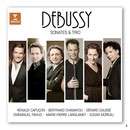
Debussy Sonates & Trio
Renaud Capuçon, Bertrand Chamayou, Géraurd Caussé, Emmanuel Pahud, Marie-Pierre Langlamet, Edgar Mor- Sonata for cello & piano in D minor - I Prologue. Lent
- Sonata for cello & piano in D minor - II Sérénade. Modérément animé
- Sonata for cello & piano in D minor - III Finale. Animé
- Sonata for cello & piano in D minor - Syrinx for solo flute
- Sonata for violin & piano in G minor - I Allegro vivo
- Sonata for violin & piano in G minor - II Intermède. Fantasque et léger
- Sonata for violin & piano in G minor - III Finale. Très animé
- Sonata for flute, viola & harp - I Pastorale. Lento, dolce rubato
- Sonata for flute, viola & harp - II Interlude. Tempo di minuetto
- Sonata for flute, viola & harp - III Finale. Allegro moderato ma risoluto
- Trio for piano, violin & cello in G major - I Andantino con moto allegro
- Trio for piano, violin & cello in G major - II Scherzo. Moderato con allegro
- Trio for piano, violin & cello in G major - III Andante espressivo
- Trio for piano, violin & cello in G major - IV Finale. Appassionato
“Claude Debussy, musicien français.” Those words have a special resonance in 2018, the year that marks the centenaries of both the great composer’s death, aged 55 on 25th March 1918, and the end of World War I. They appeared on the covers of the published editions of the three sonatas Debussy wrote in the last years of his life, and which form the major part of this album of his chamber works. It features six of today’s leading Gallic instrumentalists: pianist Bertrand Chamayou, flautist Emmanuel Pahud, violinist Renaud Capuçon, cellist Edgar Moreau, viola player Gerard Caussé and harpist Marie-Pierre Langlamet. They form a panorama of distinguished musiciens français that embraces several generations, with Caussé born in the late 1940s, Langlamet, Pahud and Capuçon between 1967 and 1976, Chamayou in 1981, and Moreau in 1994.
Debussy’s intention in 1915 was to assert the essence of French music in a series of six sonatas for various instrumental combinations. In the event, over the period to 1917, he only completed three of them: for cello and piano, for flute, viola and harp, and for violin and piano. Along with the Études for piano, these sonatas are among his last major works and on this album they are brought together with the haunting Syrinx for solo flute, dating from 1913 and – from the very early days of the composer’s career – the Trio in G major for piano, violin and cello. Written in Italy in 1880, when the 18-year-old Debussy was in the employ of Nadezhda von Meck (best known as Tchaikovsky’s patron), it was not published until 1986.
The mature Debussy, deeply distressed by the Great War and also seriously ill, was making something of a political point with his patriotic emphasis on France’s musical heritage. Like so many other French composers in the latter part of the 19th century, he had been mesmerised by Wagner – his Pélléas et Mélisande, premiered in 1902, has close parallels with Tristan und Isolde, after all – but in his late sonatas he wanted to evoke such masters of the Baroque as Couperin and Rameau. Having opened up new, fluidly iridescent musical horizons with such works such as his Préludes for piano (written between 1909 and 1913) and his groundbreaking ballet score Jeux (1912-13) he also wanted to reconnect explicitly with Classical form. If that suggests a certain rigour, characteristic French charm and volupté are by no means absent from these sonatas – it is worth remembering that Debussy originally subtitled the cello sonata ‘Pierrot fâché avec la lune’ (Pierrot angry with the moon).
Bertrand Chamayou, who performs in three of the five works on this disc, has recorded the complete piano works of Ravel, a composer often paired with Debussy, prompting Gramophone to speak of “revelatory performances of breathtaking beauty and incomparable power,” and to say that “No-one who loves French music or exquisite piano-playing will want to miss this.” In an interview with the French magazine Piano, Chamayou emphasised the importance of Debussy’s place in history: “You can sense traces of Debussy’s influence – whether conscious or unconscious, obvious or almost imperceptible – in all music that comes after him, not necessarily so much in matters of melody and harmony, but in the way the sound itself is handled.”