
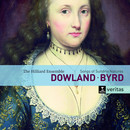
Dowland: Ayres/Byrd: Songs of Sundrie Natures
Hilliard EnsembleCD1
- The Firste Booke of Songes or Ayres : Go crystal tears
- The Firste Booke of Songes or Ayres : Awake sweet love, thou art returned
- The Firste Booke of Songes or Ayres : His golden locks Time hath to silver turned
- The Firste Booke of Songes or Ayres : Now, O now I needs must part
- The Second Booke of Songs or Ayres : A shepherd in a shade
- The Third and Last Booke of Songsor Aires : What if I never speed?
- Lamentatio Henrici Noel : O Lord, turn not away thy face
- Lamentatio Henrici Noel : Lord, in thy wrath reprove me not
- Lamentatio Henrici Noel : O Lord, consider my distress
- Lamentatio Henrici Noel : O Lord, of whom I do depend
- Lamentatio Henrici Noel : Where righteousness doth say
- Lamentatio Henrici Noel : Lord, to thee I make my moan
- Lamentatio Henrici Noel : Lord, hear my prayer, hark the plaint
- A Pilgrimes Solace : Disdain me still, that I may ever love
- A Pilgrimes Solace : Tell me, true Love
- A Pilgrimes Solace : Thou mighty God The first Part
- A Pilgrimes Solace : When David’s life The second Part
- A Pilgrimes Solace : When the poor cripple The third Part
- A Pilgrimes Solace : Welcome, black night
- A Pilgrimes Solace : Cease, cease these false sports
CD2
- Praise our Lord all ye Gentiles
- Have mercy upon me, O God
- Make ye joy to God
- Come to me grief for ever
- Christ rising again
- From virgin’s womb
- A Carowle for Christmas day
- Ye sacred muses 3:358 Turn our captivity, O Lord
- Lulla, lullaby
- Who made thee, Hob, forsake the plough?
- Come, woeful Orpheus
- Though Amaryllis dance in green
The two composers brought together here both found themselves somewhat out of step with their times, often working at arm’s length from the establishment and prone to a high-minded seriousness in their music which bordered on the melancholy. William Byrd appears to have had the more conspicuously successful career. He was trained at the Chapel Royal under Thomas Tallis, appointed organist and choirmaster of Lincoln Cathedral in his early twenties and in 1575 was granted (with
Tallis) the first monopoly of music print -ing in England. He bought his own country estate in Essex in 1593 and at his death was venerated at home and abroad – he was described in the official Chapel Royal record as ‘a Father of Musick’. Yet for all these out -ward signs of success his professed Catholic faith rendered his livelihood precarious and his position in society dependent on the support of friends in high places.
It was also rumoured that John Dowland had ‘popish sympathies’, but having fewer well-placed friends than his older contem -porary he found it much harder to secure a court appointment. So he spent much of his career as a freelance lutenist in Italy, Germany and Denmark. While Byrd was described as being ‘naturally disposed to Gravity and Piety’, Dowland was a more volatile character, and when he finally secured a court position as lutenist to Christian IV, King of Denmark in 1598, his
temperament and many absences led to his dismissal a few years later. According to one contemporary he ‘slipt many opportuni -ties in advancing his fortunes’, and by the time he was finally granted a position as one of the five lutenists to the court of James I in 1612, it was but small reward for one of the most famous musicians in Europe. Byrd is represented here by a selection of works from his first three printed collections of English music: Psalmes, Sonets and Songs
(1588), Songs of Sundrie Natures (1589) and Psalmes, Songs and Sonnets (1611). As their titles suggest, the contents of these volumes are surprisingly diverse, with the distinction between sacred and secular more a matter of function than style, but each collection is linked by its overall conception as ‘private music’ for the home.
Byrd was a reluctant madrigalist, prefer -ring the English consort song for the greater opportunities it offered for mixing voice and viols. But he nevertheless included a few representative madrigals in his collections, like the serious ‘Come woeful Orpheus’ which pays homage to the Italian style in its express -ive chromatic touches, and ‘Who made thee, Hob’ which has a down-to-earth rustic charm. More typical of Byrd are the consort songs
‘Come to me grief for ever’, a lament on the death of Sir Philip Sidney, and his most personal utterance, ‘Ye sacred muses’, an elegy on the death in 1585 of his teacher and friend Thomas Tallis. Closely related to the consort songs are the verse anthems, a form Byrd pioneered. In ‘Christ rising again’ (1589), one of Byrd’s best-known works during his lifetime, short choruses are interjected into the texture, dividing the solos into ‘verses’.
The Hilliard Ensemble experimentally perform Byrd’s works with Elizabethan pronunciation in order to ‘characterise the expressive qualities of the text’ with greater richness and rhetorical power. They also take a fresh approach to Dowland’s vocal music, published in five collections between 1597 and 1612. Although Dowland is celebrated as one of England’s foremost song writers, many of his songs were printed as ensemble pieces for four voices and lute. This may have been
essentially a publishing gambit designed to increase sales, but since the music was often performed like this at the time, and the additional voices bring added variety and depth, there is much to be enjoyed by hearing these songs performed once again by a vocal ensemble. Dowland’s seven psalm settings in memory of his patron Henry Noel (1597) are unusual in having been originally conceived for four voices. Outwardly they obey the regular phraseology of contemporary psalmody, but inwardly
reveal the melodic and harmonic touches of Dowland’s songbooks. ‘Tell me, true Love’ from A Pilgrimes Solace (1612), on the other hand, was clearly conceived as a solo monody with a separate chorus and shows how open Dowland was to the latest develop -ments in declamatory song writing in Italy.
Simon Heighes, 2015