
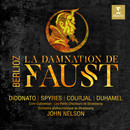
Hector Berlioz: La Damnation de Faust (CD2 + DVD)
John Nelson, Joyce DiDonato, Michael Spyres, Nicolas Courjal, Alexandre Duhamel, Coro Gulbenkian, SCD1:
- Scène I: Plaines de Hongrie: Le vieil hiver a fait place au printemps, Faust
- Scène II: Ronde de paysans : Les bergers laissent leurs troupeaux, Chœur de paysans, Faust
- Scène III : Une autre partie de la plaine : Mais d'un éclat guerrier, Faust
- Scène III : Marche hongroise
- Scène IV : Nord de l’Allemagne: Sans regrets j'ai quitté les riantes campagnes, Faust
- Scène IV : Chant de la Fête de Pâques : Christ vient de ressusciter!, Chœur de chrétiens, Faust
- Scène IV : Chant de la Fête de Pâques : Hélas! doux chants du ciel, Faust
- Scène IV : Scène V: Ô pure émotion! Mephistopheles, Faust
- Scène VI : La cave d’Auerbach à Leipzig : À boire encor! / Chœur de buveurs : Oh! qu’il fait bon, Chœur de buveurs, Méphistophélès, Brander
- Scène VI :Chanson de Brander : Certain rat, dans une cuisine, Brander, Chœur de buveurs, Méphistophélès
- Scène VI :Fugue sur le thème de la chanson de Brander : Amen, Brander, Chœur de buveurs
- Scène VI :Fugue sur le thème de la chanson de Brander : Vrai Dieu, messieurs, Méphistophélès, Chœur de buveurs
- Scène VI :Chanson de Méphistophélès : Une puce gentille, Méphistophélès, Chœur de buveurs
- Scène VI :Chanson de Méphistophélès : Assez! fuyons ces lieux, Faust, Méphistophélès
- Scène VII :Air de Méphistophélès : Voici des roses, Méphistophélès
- Scène VII :Chœur de gnomes et de sylphes / Songe de Faust : Dors, dors heureux Faust, Chœur de gnomes et de sylphes, Méphistophélès, Faust
- Scène VII :Ballet des sylphes
- Scène VII :Margarita!, Faust, Méphistophélès
- Scène VIII – Final :Chœur de soldats : Villes entourées, Chœur de soldats
- Scène VIII – Final :Chanson d’étudiants : Jam nox stellata velamina pandit, Chœur d’étudiants
- Scène VIII – Final :Chœur de soldats et chanson des étudiants ensemble : Villes entourées / Jam nox stellata, Chœur de soldats, Chœur d’étudiants, Faust, Méphistophélès
CD2
- Scène IX :Tambours et trompettes sonnant la retraite
- Scène IX : Air de Faust : Merci, doux crépuscule!, Faust
- Scène X : Je l'entends!, Méphistophélès, Faust
- Scène XI : Que l'air est étouffant!, Marguerite
- Scène XI : Le roi de Thulé : Autrefois un roi de Thulé, Marguerite
- Scène XII : Évocation : Esprits des flammes inconstantes, Méphistophélès
- Scène XII : Menuet des follets
- Scène XII : Maintenant, chantons à cette belle, Méphistophélès
- Scène XII : Sérénade de Méphistophélès : Devant la maison, Méphistophélès, Chœur de follets
- Scène XIII : Final: Duo, Trio et Chœur : Grand Dieu!, Marguerite
- Scène XIII : Final: Duo, Trio et Chœur : Ange adoré, Faust, Marguerite
- Scène XIV : Trio et Chœur : Allons, il est trop tard!, Méphistophélès, Marguerite, Faust, Chœur de voisins dans la rue
- Scène XIV : Trio et Chœur : Je connais donc enfin, Faust, Méphistophélès, Marguerite, Chœur de voisins dans la rue
- Scène XV : Romance : D'amour l'ardente flamme, Marguerite
- Scène XV : Romance : Au son des trompettes, Chœur de soldats, Marguerite, Chœur d’étudiants
- Scène XVI : Invocation à la nature : Nature immense, Faust
- Scène XVII : Récitatif et chasse : À la voute azurée, Méphistophélès, Faust
- Scène XVIII : La Course à l’abime : Dans mon cœur retentit sa voix désespérée, Faust, Chœur de paysans, Méphistophélès
- Scène XIX : Pandæmonium : Ha! Irimiru Karabrao!, Chœur de damnés et de démons, Les Princes des Ténèbres, Méphistophélès
- Scène XIX : Pandæmonium : Tradioun Marexil fir trudinxé burrudixé!, Chœur de damnés et de démons
- Épilogue : Sur la terre : Alors l'enfer se tut, Quelques voix
- Épilogue : Dans le ciel : Laus! Laus! Hosanna! Hosanna!, Chœur d’esprits célestes, Une voix
- Épilogue : Apothéose de Marguerite : Remonte au ciel, âme naïve, Chœur d’esprits célestes
- Épilogue : Apothéose de Marguerite : Viens, les vierges divines, Chœur d’esprits célestes, Chœur d’enfants, Une voix
BONUS DVD:
- Highlights from the live concert, 25 April 2019
- Marche hongroise
- Une puce gentille, Nicolas Courjal
- Grand Dieu... Ange adoré, Joyce DiDonato, Michael Spyres
- D’amour l’ardente flamme: Au son des trompettes, Joyce DiDonato, Chorus
- Nature immense, Michael Spyres
- La course à l’abîme: Pandæmonium, Michael Spyres, Nicolas Courjal, Chorus
“The most dramatic piece that Berlioz ever wrote,” is how conductor John Nelson describes La Damnation de Faust. Based on Goethe’s Faust and first performed in 1846, it is an epic hybrid of oratorio and opera – a ‘légende dramatique’ according to the composer, who recognised that its greatest potential lay in firing the audience’s imagination: “Music has great wings,” he said, “but the walls of a theatre do not allow it to spread them to the full.”
This recording was made in the Auditorium Erasme in Strasbourg in April 2019, two years after Nelson, the Orchestre Philharmonique de Strasbourg and a superb cast including Joyce DiDonato, Michael Spyres and Nicolas Courjal brought Berlioz’s Les Troyens to life in the same venue. The associated Erato recording of the huge two-part opera has gone on to win unalloyed praise and multiple major prizes. As the New York Times wrote: “Berlioz’s epic opera has rarely been given such luxury treatment as in this magnificent live recording from France.”
For La Damnation de Faust, Nelson, DiDonato, Spyres and Courjal – described by France Musique as a ‘dream team” – were joined by French baritone Alexandre Duhamel. Capturing the thrill of the occasion, and remembering the impact of Les Troyens, Bachtrack wrote: “Lightning, they say, never strikes in the same place twice. If that's the case, then somebody please explain the scorch marks streaked across Strasbourg's Palais de la Musique et des Congrès ... Nelson wove Berlioz's fantastical score miraculously and meticulously.”
The Times, also giving a five-star review to the performance, said: “Strasbourg is a kind of meeting point between France and Germany — and in a way so is Damnation, in which the extravagance of Berlioz’s writing meets the philosophical rigour of Goethe. The conductor favours this orchestra, too, for its Gallic colours and Germanic discipline. It makes an impressive blend. The Hungarian March, kicked off by Nelson with deceptive calm, built up to a strutting, testosterone-fuelled climax. Amid the great setpieces, however, one admired the sinuous delicacy of the OPS’s playing: the gauzy strings accompanying the devil’s serenade, ‘Voici des roses’, the eerie woodwind tinkle of the infernal spirits, and the two instrumental partners in Marguerite’s big arias, first a silky viola, then a luminous cor anglais ... Vivid characters massed behind the orchestra — the Coro Gulbenkian, a virtuosic Portuguese choir who played impeccable Easter celebrants, lusty peasants and outrageously raucous students, but saved the best for worst as the cacophonous imps of Hell. Their richly detailed performances set the tone for the soloists. Nicolas Courjal’s Méphistophélès … took wicked ownership of the text, playing Faust like a fish on a line. This is a devil who would happily pour the champagne at the same time as impaling your nether regions with a pitchfork. He made a compelling foil for Spyres’s ardent, doomed and near unsurpassable Faust. He’s a fearless tenor who can do baritonal strength as well as spinetinglingly floated high notes, and who — by the end of the night — seemed utterly under the spell of Mephisto and Berlioz ... DiDonato [was] a Marguerite of marvellous elegance and vulnerability, close to delirium in her last scene, an emotion the whole audience could partake in when it was all over.”
The central role of Faust is closely identified with Michael Spyres. Le Monde pointed out that the character had resonances for Berlioz himself: “An alter ego condemned to solitude, a spirit too large for a small world … the archetypal Romantic hero.” The online magazine Toute la culture observed that the tenor “took such a grip on Faust’s character that he became indistinguishable from … the man who has sold his soul to the devil, a timeless poetic and romantic character … He [Spyres] was possessed, not by Méphistophélès, but by the music … When everything came to an end, there was an almost religious silence … before thunderous applause broke out. Amidst the acclaim Michael Spyres wiped tears from his eyes … What a musical experience this had been for us all!”