
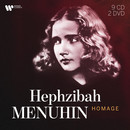
Hephzibah Menuhin Homage (CD9 + DVD)
Hephzibah MenuhinCD1
- Speech by Hephzibah Menuhin interviewed by Henri Jaton for Radio Télévision Suisse
- WOLFGANG AMADEUS MOZART 1756-1791 : Violin Sonata No. 35 in A major, K. 526 : I. Molto allegro
- WOLFGANG AMADEUS MOZART 1756-1791 : Violin Sonata No. 35 in A major, K. 526 : II. Andante
- WOLFGANG AMADEUS MOZART 1756-1791 : Violin Sonata No. 35 in A major, K. 526 : III. Presto
- Violin Sonata No. 24 in F major, K. 376 : I. Allegro
- Violin Sonata No. 24 in F major, K. 376 : II. Andante
- Violin Sonata No. 24 in F major, K. 376 : III. Rondo - Allegro grazioso
- Concerto for piano and orchestra No. 12 in A major, K. 414 : I. Allegro
- Concerto for piano and orchestra No. 12 in A major, K. 414 : OI. Andante
- Concerto for piano and orchestra No. 12 in A major, K. 414 : III. Rondo allegretto
CD2
WOLFGANG AMADEUS MOZART 1756-1791
- Piano Concerto No. 14 in E-flat major, K. 449 :
- Piano Concerto No. 14 in E-flat major, K. 449 : I. Allegro vivace
- Piano Concerto No. 14 in E-flat major, K. 449 : II. Andantino
- Piano Concerto No. 14 in E-flat major, K. 449 : III. Allegro ma non troppo
- Piano Concerto No. 19 in F major, K. 459 :
- Piano Concerto No. 19 in F major, K. 459 : I. Allegro
- Piano Concerto No. 19 in F major, K. 459 : II. Allegretto
- Piano Concerto No. 19 in F major, K. 459 : III. Allegro assai
- Concerto for Two Pianos No. 10 in E-flat major, K. 365 : I. Allegro
- Concerto for Two Pianos No. 10 in E-flat major, K. 365 : II. Andante
- Concerto for Two Pianos No. 10 in E-flat major, K. 365 : III. Rondo – Allegro
CD3
OHANN SEBASTIAN BACH 1685-1750
- Violin Sonata No. 3 in E major, BWV 1016 : I. Adagio
- Violin Sonata No. 3 in E major, BWV 1016 : II. Allegro
- Violin Sonata No. 3 in E major, BWV 1016 : III. Adagio, ma non tanto
- Violin Sonata No. 3 in E major, BWV 1016 : IV. Allegro
LUDWIG VAN BEETHOVEN 1770-1827
Violin Sonata No. 7 in C minor, Op. 30 No. 2
- I. Allegro con brio
- II. Adagio cantabile
- III. Scherzo & Trio – Allegro
- IV. Finale - Allegro - Presto
Violin Sonata No. 3 in E-flat major, Op. 12 No. 3
- I. Allegro con spirito
- II. Adagio con molt'espressione
- III. Rondo - Allegro molto
CD4
LUDWIG VAN BEETHOVEN 1770-1827
Piano Sonata No. 31 in A-flat major, Op. 110
- I. Moderato cantabile molto espressivo
- II. Allegro molto
- III. Adagio ma non troppo – Fuga. Allegro ma non troppo
WOLFGANG AMADEUS MOZART 1756-1791
Sonata for Two Pianos in D major, K. 448
- I. Allegro con spirito
- II. Andante
- III. Molto allegro
JOHANNES BRAHMS 1833-1897
Liebeslieder-Walzer, Op. 52
- I. Rede, Mädchen, allzu liebes 0.00
- II. Am Gesteine rauscht die Flut 0.00
- III. O die Frauen (tenor & bass) 0.00
- IV. Wie des Abends schöne Röte (soprano & mezzo soprano) 0.00
- V. Die grüne Hopfenranke 0.00
- VI. Ein kleiner, hübscher Vogel 0.00
- VII. Wohl schön bewandt war es (mezzo soprano) 0.00
- VIII. Wenn so lind dein Augen mir 0.00
- IX. Am Donaustrande 0.00
- X. O wie sanft die Quelle 0.00
- XI. Nein, est ist nicht auszukommen 0.00
- XII. Schlosser auf, und mache Schlösser 0.00
- XIII. Vögelein durchrauscht die Luft (soprano & mezzo soprano) 0.00
- XIV. Sieh, wie ist die Welle klar (tenor & bass) 0.00
- XV. Nachtigall, sie singt so schön 0.00
- XVI. Ein dunkeler Schacht ist Liebe. 0.00
- XVII. Nicht wandle, mein Licht (tenor) 0.00
- XVIII. Es bebet das Gesträuche 0.00
CD5
JOHANNES BRAHMS 1833-1897
Violin Sonata No. 1 in G major, Op. 78
- I. Vivace ma non troppo
- II. Adagio
- III. Allegro molto moderato
Clarinet Sonata No. 1 in F minor, Op. 120 No. 1
- I. Allegro appassionato
- II. Andante un poco adagio
- III. Allegretto grazioso
- IV. Vivace
Clarinet Sonata No. 2 in E-flat major, Op. 120 No. 2
- I. Allegro amabile
- II. Appassionato, ma non troppo allegro
- III. Andante con moto - Allegro non troppo
- IV. Allegro non troppo
CD6
ROBERT SCHUMANN 1810-1856
Violin Sonata No. 2 in D minor, Op. 121
- I. Ziemlich langsam - Lebhaft
- II. Sehr lebhaft
- III. Leise, einfach
- IV. Bewegt
Piano Concerto No. 1 in D minor, Op. 15
- I. Maestoso
- II. Adagio
- III. Allegro non troppo
CD7
FRANZ SCHUBERT 1797-1828
- Rondeau brilliant in B minor, D. 895 0.00
Piano Quintet in A major, D667 'Trout'
- I. Allegro vivace 0.00
- II. Andante 0.00
- III. Scherzo (Presto) 0.00
- IV. Tema. Andantino 0.00
- V. Finale (Allegro giusto) 0.00
CAMILLE SAINT-SAËNS 1835-1921
Le Carnaval des animaux, R. 125
- I. Introduction et Marche royale du lion
- II. Poules et coqs
- III. Hémiones (ou Animaux véloces)
- IV. Tortues
- V. L'Éléphant
- VI. Kangourous
- VII. Aquarium
- VIII. Personnages à longues oreilles
- IX. Le Coucou au fond des bois
- X. Volière
- XI. Pianistes
- XII. Fossiles
- XIII. Le Cygne
- XIV. Finale
CD8
BÉLA BARTÓK 1881-1945
Violin Sonata No. 1, Sz. 75
- I. Allegro appassionato
- II. Adagio
- III. Allegro
CLAUDE DEBUSSY 1862-1918
Sonata for violin and piano, CD 148
- I. Allegro vivo
- II. Intermède. Fantasque et léger
- III. Finale. Très animé
GEORGE ENESCU 1881-1955
Violin Sonata No. 3 in A minor, Op. 25 "Dans le caractère populaire roumain"
- I. Moderato malinconico
- II. Andante sostenuto e misterioso
- III. Allegro con brio, ma non troppo mosso
CD9
FELIX MENDELSSOHN 1809-1847
Concerto for piano, violin and strings in D dinor, MWV O 4
- I. Allegro
- II. Adagio
- III. Allegro molto
JUAN JOSÉ CASTRO 1895-1968
Piano Concerto
- I. Allegro vivo
- II. Tragico
- III. Allegro vivo
“An independent spirit, a gracious, generous woman who was also deserving of a place among the great pianists of the 20th century.” Hephzibah Menuhin is summed up in those word by Bruno Monsaingeon, who was close to both her and her dazzlingly famous violinist brother, Yehudi. The distinguished French filmmaker has curated this 11-disc box (9CDs and 2DVDs), spanning the years from 1933 to 1980, the year before Hephzibah Menuhin’s death at the age of 60. Containing a substantial proportion of world premiere releases – live performances and TV interviews – Hephzibah Menuhin: Homage documents the pianist in her familiar role as her brother’s duo partner and sheds new light on her prowess as a recitalist and concerto soloist. It also provides fascinating insights into her life, her relationship with Yehudi and her humanitarian beliefs and activities.
The pianist Hephzibah Menuhin, whose centenary fell in May 2020, died 40 years ago, on 1st January 1981, aged 60.
She made a substantial career as a soloist in concerto and recital, but the musical public knows her best as the duo partner of her brother Yehudi, one of the most celebrated violinists of the 20th century; they performed together in public from the time she was 13 and he was 17. Hephzibah Menuhin: Homage contains many recordings they made together as a duo, but also documents her distinction as a recitalist and concerto soloist.
“An independent spirit, a gracious, generous woman who was also deserving of a place among the great pianists of the 20th century,” is how Hephzibah Menuhin is described by Bruno Monsaingeon, who has curated this box. He knew her personally and has provided the booklet note. In his work as a film and TV director, Monsaingeon has made important documentaries on Yehudi Menuhin and such similarly towering figures as Sviatoslav Richter, David Oistrakh, Glenn Gould and Dietrich Fischer-Dieskau.
The Australian music professor Gerard Willems sees Hephzibah Menuhin as: "… a musician’s musician. She always thought of the music and what it needed, and played it with the expressiveness the composer demanded. She was mindful of the piano’s role in other musical textures and judged her playing according to that.”
In a French TV interview from 1969, included here, she said that: “Music is the link to everything that is best in life. It connects one directly with all sorts of joys, with the disciplines one appreciates … and with huge rewards … [As a member of an audience] you are as safe and sound as can be, provided the artist is doing his best. I think you are in an environment that is good for you, that is good for your spiritual health.”
Yehudi Menuhin spoke of his musical partnership with Hephzibah as “a natural extension of our relation as brother and sister. It was a matter of setting to music a relationship that already existed before we began playing together … Our sonata partnership bore the stamp of inevitability, it had to be … [We were] equal voices in dialogue with one another; and being so close, needing to make no effort to bend and blend our personalities.”
In addition to her musical career, Hephzibah Menuhin devoted considerable time and energy to humanitarian activities, notably setting up home in the socially deprived East End of London so that she and her sociologist husband could help children and adults in need. She also gave many concerts for charitable causes. Shortly after her death, her sister-in-law, Diana Menuhin said that, “Hephzibah was like a gyro compass. Rough seas or not, she always found her centre. Nothing rattled her. They said at her funeral that she was a saint, and she was.''
Hephzibah Menuhin was born on May 20, 1920 in San Francisco, where she initially learned the piano as a young child. When the Menuhin family moved to Europe in the second half of the 1920s, she studied with Marcel Ciampi in Paris and with Rudolf Serkin in Basel.
Her brother Yehudi was already internationally renowned by the time Hephzibah gave her first public piano recital, back in San Francisco, at the age of eight. Her parents then kept her off the concert stage until she was 14, when she began giving concerts with her brother. In a newspaper interview her mother said: “Hephzibah yearns for solo recitals and a career of her own.... I tell her that the only immortality to which a woman should aspire is that of a home and children.”
In 1933, Hephzibah and Yehudi made a prizewinning recording (included here), of Mozart’s Violin Sonata in A.
By the time she reached her teens, Hephzibah could speak English, Hebrew, French, German, Italian, Spanish, and Russian. In 1938 she married a wealthy Australian and spent most of the 1940s in Australia, where she raised two sons while also giving numerous concerts. In 1947, after a break of nearly 10 years, she and Yehudi re-established their performing partnership for the long term.
In 1954 she left her husband and in 1955 married the sociologist Robert Hauser. The couple moved to the UK, where she gave birth to a daughter. In London the Hausers worked with the poor and homeless, and Hephzibah also served as president of the Women’s International League for Peace and Freedom. She carried on with her busy performing career until a short time before her death from cancer in 1981.
Hephzibah Menuhin: Homage
It comprises 9CDs and 2 DVDs. The recordings span the years from 1933 to 1980 and a substantial proportion of them are world premiere releases of live recordings: a third of the audio recordings and the majority of the video recordings (performances and interviews).
In addition to documenting Hephzibah Menuhin’s collaboration with her brother, Bruno Monsaingeon has sought out rare and previously unreleased recordings that shed new light on the scope of stature of her talent – perhaps previously underestimated owing to the circumstances of her life and career (such as the public’s identification of her with her almost overwhelmingly famous brother, her diplomatic and collaborative personality, her move to live in Australia when she get married at a young age, and the time and energy she devoted to her humanitarian work).
The audio recordings include:
Hephzibah and Yehudi performing together. The 1973 recording of Sonata No. 3 by Enescu (who was Yehudi’s teacher), from Romanian Radio, is a world premiere release.
Hephzibah as a soloist in Mozart, Beethoven, Brahms and, in the world premiere release of a 1953 recording from the Australian Broadcasting Corporation, the piano concerto by the Argentinian composer Juan José Castro (1895-1968).
Other performers appearing in the collection include the pianists Jeremy Menuhin (Yehudi’s son) and Louis Kentner, members of the Amadeus Quartet and Dame Janet Baker.
The video recordings include:
World premiere releases of Hephzibah and Yehudi performing at the United Nations, New York and in TV show Berlin; Hephzibah in TV recital and UNICEF concert in Paris; Mozart’s Piano Concerto No 27 with Rudolf Kempe in London.
Hephzibah, Jeremy and Yaltah (Yehudi and Hephzibah’s younger sister) performing Mozart’s Concerto for Three Pianos, with Yehudi conducting the London Philharmonic Orchestra (BBC, 1966)
TV interviews with Hephzibah, with Hephzibah and Yehudi, and with Hephzibah, Yehudi and Yaltah.