
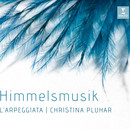
Himmelsmusik
Celine Scheen, Philippe Jaroussky, Jésus Rodil, Dingle Yandell- Theile: Nun, Ich Singe, Gott, Ich Knie (Der Sionitin Wiegenlied)
- Bach: Ach, Dass Ich Wassers G'nug Hätte (Lamento)
- Bütner: Ich Suchte Des Nachts In Meinem Bette
- Theile: Gott, Hilf Mir
- Ritter: O Amantissime Sponse
- Chiaccona A 4 In C (Anonymous)
- Schütz: Von Gott Will Ich Nicht Lassen
- Erlebach: Kommt, Ihr Stunden, Macht Mich Frei
- Tunder: Ein Kleines Kindelein (Aria)
- Ahle: Bleibbei Uns, Denn Es Will Abend Werden
- Bertali: Sonata A 6 In E Minor
- Schütz: Erbarm Dich Mein, O Herre Gott
- Bach: Komm, Süßer Tod, Komm, Sel'ge Ruhl
Himmelsmusik (‘heavenly music’), a programme of sacred songs and cantatas by German composers of the 17th century, presents a striking contrast with the previous Erato album from Christina Pluhar and her ensemble L’Arpeggiata: Händel Goes Wild.
Himmelsmusik sees Pluhar taking a more sober and traditionally scholarly approach. She and L’Arpeggiata are joined by star countertenor Philippe Jaroussky and the distinguished Belgian soprano Céline Scheen in a programme that includes the celebrated lamento ‘Ach, dass ich Wassers gnug hätte’ by Johann Christoph Bach (born over 40 years before his relative Johann Sebastian), Heinrich Schütz’s ‘Erbarm Dich mein, o Herre Gott’ and prompts discovery of works by such lesser-known figures as
Johann Theile, Philipp Heinrich Erlebach, Christian Ritter and Franz Tunder. An instrumental piece by the Verona-born Antonio Bertali highlights the influence of Italian music on German composers of the time.
In an interview with the Bremen-based newspaper Weser-Kurier, Christina Pluhar provided some insights into the balance she strikes in her music-making with L’Arpeggiata.
“A way of escaping any categorisation as a specialist in improvisation is to undertake projects in which I play pure Baroque music. I always try to reinvent myself, to create something from my innermost being … I can be quite satisfied with music as it was originally written, and we will play this music without making excursions into other fields … But it is also always exciting to look at this music through the eyes of musicians who come from a different musical genre, since it opens up new
perspectives and gives rise to a kind of new music. That can only work when you are well acquainted with the original music and its style, and have great respect for it … There are pieces that lend themselves to being developed into something new, and there are others that must simply be presented in all their purity and beauty – works which must be left as they are. Sensitivity is everything.”