
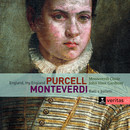
Monteverdi: Balli e Baletti/Purcell: England, My England
John Eliot Gardiner, Monteverdi Choir, English Baroque SoloistsCD1
- Tirsi e Clori
- Lasciate i monti balletto
- Vieni Imeneo
- Ecco pur ch’a voi ritorno
- Moresca
- De la bellezza le dovute lodi
- Il ballo delle ingrate
- Volgendo il cie
CD2
- Sonata for trumpet and strings: Allegro
- Sonata for trumpet and strings: Adagio
- Sonata for trumpet and strings: Allegro
- The Married Beau: Ouverture: Come ye Sons of Art
- Come ye sons of art
- Sound the trumpet
- Saul and the Witch of Endor
- The Indian Queen: Adagio
- King Arthur: Fairest Tale
- Upon a quiet conscience
- Dido and Aeneas: Thy hand, Belinda... When I am laid in earth
- Music for the Funeral of Queen Mary: March
- Music for the Funeral of Queen Mary: Man that is born of a woman
- Music for the Funeral of Queen Mary: Canzona
- Music for the Funeral of Queen Mary: In the midst of life we are in death
- Music for the Funeral of Queen Mary: Thou know’st, Lord, the secrets of our hearts
- Abdelazer, or The Moor’s Reveng: Rondeau
- King Arthur : Act One: Come if you dare
- King Arthur : Prelude
- King Arthur : Cupid What ho! thou genius of this isle
- King Arthur : Cold Genius What power art thou
- King Arthur : Cupid Thou doting fool, forbear
- King Arthur : Cold Genius Great Love, I know thee now
- King Arthur : Cupid No part of my dominion
- King Arthur : Prelude
- King Arthur : Chorus See, see, we assemble
- King Arthur : Cupid ’Tis I that have warmed ye / Chorus ’Tis Love that has warmed us
- King Arthur : Cupid, Cold Genius Sound a parley
- King Arthur : Third Act Tune: Hornpipe
The birth of opera around the beginning of the seventeenth century was not quite the watershed we might imagine. Arresting though the new idea of ‘speaking in music’ was, it was an avant-garde development that took time to take root. The earliest operas were written by talented singers, but it required a seasoned composer to breathe real life into the fledgling form. Claudio Monteverdi began his career in the service of the Dukes of Gonzaga, and it was for a modest occasion at the Mantuan
court in 1607 that he wrote Orfeo, his first opera. It is a work with one foot in the Renaissance and one in the Baroque, cleverly mixing well-established theatrical traditions with the powerful new resources of speech-like recitative. It was the dance-based choruses, songs and instrumental pieces with which the first audiences would have been accustomed, and in the first three excerpts from Orfeo included here Monteverdi deliberately drew on this reassuringly
familiar style to set the mood of Orpheus’s idyllic happiness before his beloved Eurydice’s death. The opera ends with a Moresca – a furious dance, possibly written specially for the publication of the score in 1609.
Fully-fledged operas were much less common in the early years of the seventeenth century than smaller, more traditional balli – part ballet, part madrigal, part opera. De la bellezza le dovute lodi (published in 1607) sets a poem by Francesco Gonzaga and consists simply of an instrumental introduction followed by six contrasting dance movements. Il ballo delle ingrate is more substantial and was written for the wedding of Francesco Gonzaga in Mantua in 1608.
It’s a cautionary tale of the fate awaiting the hard-hearted in love. These women, though ultimately con -demned to remain in ‘the infernal kingdom’, take the stage one last time for several affecting dances.
Tirsi e Clori was commissioned by the Gon -zagas in 1615, after Monteverdi had left to work in Venice. His letters to his old employers record that he envisaged the performers arranged ‘in a half moon … with Chloris and Thyrsis at the corners accompany ing them -selves on their own instruments’. Volgendo il ciel is the only work here not commissioned by the Gonzaga family, and was written around 1637 for the Austrian emperor Ferdinand III. The Poet
appears with his attendants and calls for wine, flowers and his lute to inspire danc -ing in praise of Ferdinand, which reaches its height in two movements in galliard rhythm, ingeniously constructed over two statements of a long ground bass.
The ‘ground’ – a repeated pattern in the bass line – was one of Henry Purcell’s favourite imports from Italy, and it under-pins some of his finest music. In ‘Sound the trumpet’ from his 1694 birthday ode for Queen Mary, an insistent two-bar ground bass sets and maintains a busy virtuosic mood. In contrast, a slow, descending, chromatic ground bass signified a lament, and in ‘When I am laid in earth’, sung by the desperate Queen at the close of Dido and Aeneas, Purcell created
an emotional tour de force whose power still resonates today.
This programme of music by Purcell, compiled for Tony Palmer’s film England, my England – The Story of Henry Purcell (1995), encompasses the composer’s stylistic range with music drawn largely from the end of his career. The most substantial extracts come from King Arthur (1690), described by one of Purcell’s contemporaries as a ‘semi opera’ – a hybrid form in which the dialogue was spoken rather than sung, and the music was unrelated to the main plot. It may
have been dramatically incidental, but the music was not inconsequential, and Purcell’s score contains two of his best-loved songs. ‘What power art thou’, from the famous Frost Scene, uses shivering declamation and painful chromaticism to conjure up the freezing cold. (Then, in a delightfully simple Rondeau, ‘Thou doting fool, forbear’, Cupid wickedly mocks the Cold Genius for his pomposity). ‘Fairest Isle’ is the only song in the opera
which cannot be ridiculed – its sincere lyricism proving that its patriotism is pure.
A similar heartfelt simplicity marks Purcell’s music for the funeral of Queen Mary in Westminster Abbey in 1695. He supplied a March and Canzona for brass, a setting of the funeral sentence ‘Thou know’st, Lord’, and revised his two earlier Burial Sentences. A contemporary account recorded that the music was ‘so rapturously fine, & solemn, & so Heavenly... [it] drew tears from all’. Eight months later the music accompanied Purcell’s own funeral.
Simon Heighes, 2015