
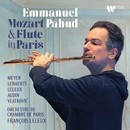
Mozart & Flute in Paris
Emmanuel Pahud, Paul Meyer, Anneleen Lenaerts, Gilbert Audin, Radovan Vlatkovic, Orchestre de ChambrCD1
- Philippe Hersant, Dreamtime
- Camille Saint-Saens, Romance Op.37
- Camille Saint-Saens, Odelette Op.162
- Cecile Chaminade, Flute Concertino Op. 107
- Francis Poulenc (orch. Berkeley), Sonate FP 164
- Allegretto malinconico
- Cantilena: assez lent
- Presto giocoso
- Gabriel Fauré (orch. Louis Aubert), Fantaisie Op. 79
- Camille Saint-Saens, Tarentelle Op. 6
CD2
- Wolfgang Amadeus Mozart
- Sinfonia Concertante for Flute, Oboe, Horn and Bassoon in E-flat Major K. 297b
- I. Allegro
- II. Adagio
- Sinfonia Concertante for Flute, Oboe, Horn and Bassoon in E-flat Major K. 297b
This double album, Mozart & Flute in Paris, brings together nine captivating works, all with their origins in Paris, which feature a solo flute. Emmanuel Pahud is joined by his colleagues from ‘wind supergroup’ Les Vents Français – oboist François Leleux (here also conducting the Orchestre de chambre de Paris), clarinettist Paul Meyer, bassoonist Gilbert Audin and horn-player Radovan Vlatković – and by Belgian harpist Anneleen Lenaerts, who has starred on three Warner Classic releases.
“The pieces on this album represent different golden ages of the flute,” says Pahud. The earliest, dating from 1778 are two concertante works that Mozart wrote on his third and final visit to Paris, at a time when the flute was a fashionable instrument in the homes of the aristocracy and bourgeoisie. The newest, premiered in 2014 by Pahud and the Orchestre de chambre de Paris, is Dreamtime by Philippe Hersant, which evokes the creation story of the Australian Aboriginal culture. (Dreamtime was also the title of a Warner Classics album released by Pahud in 2019; it features another piece that draws on Aboriginal philosophy, Toru Takemitsu’s I hear the water dreaming.)
France has had a special relationship with the flute since the time of Louis XIV and his court composer Jean-Baptiste Lully. In the latter part of the 19th century the flautist Paul Taffanel (1844-1908) became a prominent figure, notable for the technical and stylistic sophistication of his playing; Professor of Flute at the Paris Conservatoire from 1893, he is seen as the father of the modern school of French flute-playing. Emmanuel Pahud studied the Paris Conservatoire, where François Leleux was among his contemporaries; Paul Meyer and Gilbert Audin are also among its distinguished alumni. Composers in Taffanel’s sphere of influence are represented by Saint-Saëns (three pieces, including the Tarantelle op 6, which calls for Pahud to duet with Meyer), Fauré, Chaminade (one of the most successful female composers of her time), and Poulenc (his flute sonata in an orchestration by the British composer Lennox Berkeley, who studied with the great French teacher Nadia Boulanger). When talking about all these pieces, Pahud enthuses about their colour, their luminosity and the memories they evoke for him.
It was the flautist Johann Baptist Wendling, a member of the pioneering orchestra at the court of Mannheim in Germany, who encouraged Mozart to seize the professional opportunities offered by Paris. Within two weeks of Mozart’s arrival in the city in 1778 (he had previously visited in 1763 and 1766), he was commissioned to write the Sinfonia Concertante for Flute, Oboe, Horn and Bassoon in E-flat major. Wendling was to be among the soloists, but for various reasons the piece was never performed. The score was lost, but a (controversial) version using clarinet rather than flute re-emerged in 1870, and in the 1980s the American musicologist Robert D Levin prepared the authoritative edition that is used on Mozart & Flute in Paris.
Wendling also played a role in the genesis of Mozart’s Concerto for Flute and Harp, since he introduced Mozart to his talented amateur pupil Adrien-Louis de Bonnières, Duc de Guînes. The Duke’s daughter, Marie-Louise Philippine, played the harp, and also took composition lessons with Mozart. If the beguiling combination of flute and harp now seems natural to us, in 1778 it represented an innovation. Mozart succeeded in writing a concerto that exemplifies the grace and elegance we associate with the aesthetics of the later 18th century.