
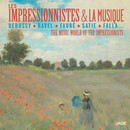
Music Of The World Impressionists
Various ArtistsCD1
- LISZT: Les jeux d’eau à la Villa d’Este
- RAVEL: Jeux d’eau : très doux
- DEBUSSY: L’isle joyeuse
- RAVEL: Miroirs : Une barque sur l’océan : d’un rythme souple
- DEBUSSY: Estampes III : Un jardin sous la pluie
- DEBUSSY: Suite bergamasque III : Clair de Lune
- DEBUSSY: Préludes Livre II, XII : Feux d’artifice
- CHABRIER: Pièces Pittoresques : Sous-bois
- FAURE: Barcarolle n°1 en la mineur, op. 26
- SATIE: Gymnopédie n°1
- SATIE: Gnossienne n°3
- SCOTT: Lotus Land (arr. Kreisler)
- RAVEL: Pièce en forme de Habanera
- FAURE: Sicilienne op. 78
- FAURE: Élégie – Gabriel Fauré
CD2
- RAVEL: Daphnis et Chloé : Lever du Jour –
- DEBUSSY: Prélude à l’après-midi d’un faune
- DE FALLA: L’amour sorcier : Danse rituelle du feu
- DELIUS: In a Summer Garden
- RESPIGHI: La Fontaine de la Vallée Giulia. À l’aube
- RESPIGHI: La Fontaine du Triton. Au matin
- RESPIGHI: La Fontaine de Trévi. À midi
- RESPIGHI: La Fontaine de La Villa Médicis. Au Coucher du Soleil
- DEBUSSY: De l’aube à midi sur la mer
- DEBUSSY: Jeux de vagues
- DEBUSSY: Dialogues du vent et de la mer
While an actual school of musical impressionism did not exist, the term, coined by art critic Louis Leroy in 1874 to describe this new movement in painting, has since been associated with composers whose work was seen as an echo of the impressionist revolution. Although the term was disliked by the composers, it is still highly appropriate to describing Orpheus’s art. The notion of a convergence of the arts is unquestionable throughout the impressionist period, roughly extending from 1860 to the beginning of the Great War and even afterwards. Much of the shimmering magic of this music and its sounds is a reminder of those well-known impressionist paintings by Manet, Renoir, Monet, Sisley or Pissarro, or the pointillists Seurat, Signac, and even the Nabi and Fauve movements.
Arguably the greatest musical impressionist, Claude Debussy often layered a wide palette of musical tones to create a subtle reflection of different movements of the period like Japonism (influences also found in Monet’s work) and most importantly, symbolism. He thus also responded to the beliefs of artists like Whistler, resulting in much more than a transient movement of nature or a fleeting moment in a social or domestic situation.
Key to this urge to give meaning to space is his highly emblematic 1894 creation, Prélude à l’après-midi d’un faune, considered to be the pillar of musical impressionism, and which positively stunned the initially sceptical Stéphane Mallarmé whose poem inspired the piece. While this work embodies the stirring of nature and its play on light, it became an ideal on the cusp of the more hedonistic works of the Golden Age. Everything was already luxuriant, peaceful and delightful. On the other hand, the combined movements of La Mer from 1905 scarcely conceal the threat of the uncontrollable force of the sea. There are suggestions of Estampe (print) art particularly at the beginning and it is interesting to note that Hokusai’s wave initially graced the cover of this piece. We thus see that the notion of impressionist art becomes diffuse as it merges into a complex alchemy of movements.
Another important creation from the early days of musical impressionism was Jeux d’eaux de la villa d’Este (1877) by the aging composer Liszt. Debussy was astounded by this piece. It echoes the wonder caused by the water gushing from the fountains of this historical site and the play of light refracted as if through a prism. Romanticism fades into a nostalgia for twilight combined with a mysticism in which the contrast but highlights the new prospects on the horizon. It is a look ahead to all ‘water music’ to come from Ravel to Respighi, honoured in this anthology, clearly synonymous with what impressionism is all about. Water is the perfect element for expressing the quintessential nature of impressionist art. The way it moves and dances with the play of light offers a multitude of abstract layers to be exploited for the pure pleasure of listeners. Indeed, listeners cannot but be sensitive to the variety of light and shade diffused: between the calm subtlety of Ravel’s Jeux d’eau, the sparkling force of Barque sur l’océan, the exhilarating force of Respighi’s Fontaines de Rome, the evanescent power of Debussy’s La Mer or the rapid, mischievous rhythm of Jardin sous la pluie.
The last piece also evokes the passing of time as also hinted at, though somewhat differently, in Faure’s La Barcarolle n° 1, with its nostalgic lilt, a rarity of sentiment which also comes up in the indescribable Sicilienne (and what a theme!) and l’Elégie. Yet time stands still when listening to the two Erik Satie pieces, which mesmerizingly create an illusion of perpetual movement contrasting with Debussy’s L’Isle joyeuse. The supple grace of the latter rejoices at the prospect of a mythical destination, while Emmanuel Chabrier evokes a carefree stroll in Sous-bois.
The panorama would not be complete without the atmosphere of landscapes. The composers managed to echo their subtle differences as did the artists. Debussy’s Clair de lune is perfection itself. Frédérik Delius’s Summer Garden is an invitation to take a whimsical stroll with moments of quiet contemplation, while Cyrill Scott’s Lotus Land takes us through a delicious fairy-tale, enhanced by Kreisler’s violin playing. However, the invitation to the grand finale comes from Maurice Ravel with his ‘daybreak’ from Daphnis et Chloé, the finest of its kind in the history of music, the epitome of flamboyance against a backdrop of an idealised Arcadia. Through its intoxicating inspiration, the modernity of the piece is still highly significant. Conducted by the young Pierre Monteux in 1912, his moving account from 1959 can be heard as he enters his twilight years.
Debussy’s fireworks fittingly close this festival of musical impressionism. We could not resist pursuing the pleasure with Manuel de Falla’s Danse du feu, and its intoxicating frenetic movement, followed by some respite with Ravel’s Pièce en forme de Habanera, whose melisma also clearly fit the impressionist mould. Both of these pieces are a timely reminder of the French artists’ fascination with Spain at the time.
As our musical journey reaches its end, the answer to the question of why impressionist art is so popular today is that its success lies in the intangible promise of happiness that it beholds. Artists like Monet or Renoir, and later Bonnard, never stopped seeking this despite the miseries of their life and times. This anthology offers the composers’ response.