
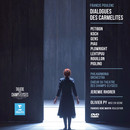
Poulenc: Dialogues Des Carmelites
Jérémie Rhorer, Philharmonia Orchestra,Sophie Koch, Patricia Petibon- Acts I. and II.
- Act III.
At the end of 2013, the year that marked the 50th anniversary of Francis Poulenc’s death, his gripping and moving operatic masterpiece, Dialogues des Carmélites was staged in Paris by director Olivier Py with a cast featuring some of France’s finest female singers – Patricia Petitbon, Véronique Gens, Sandrine Piau and Sophie Koch – under the baton of Jérémie Rohrer. Le Figaro described the production as “a thing of wonder,” while Le Monde called it: “A masterpiece ... the most exciting and
consummately achieved show to have been seen on a Parisian stage in a long time … This was great work, magisterial and unforgettable.”
“The memorable Dialogues des Carmélites at the Théâtre des Champs-Elysées marked the climax of commemorative activities for the 50th anniversary of Poulenc’s death,” wrote Opera magazine of the production of Poulenc’s gripping and moving opera that was staged by the French director Olivier Py in Paris in December 2013.
Among operas composed in the post-War era, Dialogues des Carmélites, first seen in 1957 at La Scala, is one of the most frequently performed and best loved. Set during the French Revolution, it tells the story of a highly-strung young aristocrat, Blanche de la Force, who seeks peace by joining a convent and finally goes to the guillotine with her fellow nuns. Faith, fear, and sacrifice are among the issues it addresses with music – sometimes austere, sometimes sensuous, sometimes both at once – that exemplifies Poulenc’s characteristic amalgam of simplicity and sophistication. Its final scene, as the nuns go one by one to their execution while singing a soaring ‘Salve regina’, is of spine-tingling pathos and power.
The stark, monochrome decor for Py’s production, designed by André Weitz, makes use of sliding panels that open and close to create the acting space or reveal expressionist vistas, while the costumes evoke the first half of the 20th century rather than the era of the Revolution itself. Especially striking is the death scene of Madame de Croissy, the old Prioress, searingly sung and acted by the British mezzo-soprano Rosalind Plowright: the audience views her agonies as if from above, since her bed is mounted vertically on the rear panel of the stage. Later in the opera, when it comes to the final night in their convent, before their expulsion by the revolutionaries, the nuns are assembled as if for the Last Supper, while the stunning, transcendent final scene is set against a starry sky.
Le Figaro described the production as “a thing of wonder” and Diapason stated that “Jérémie Rohrer’s conducting and Olivier Py’s production deserve nothing but praise.” Le Monde, France’s most authoritative newspaper wrote thus: “A masterpiece! This production of Dialogues des Carmélites is the most exciting and consummately achieved show to have been seen on a Parisian stage in a long time … A rare marriage of music and theatre ... each of the women is characterised in detail and their relationships are minutely observed ... This was great work, magisterial and unforgettable.”
Le Monde went on to acclaim: “A cast of exceptional quality, with some of France’s finest singers, led by Patricia Petibon [as Blanche] … whose timbre, use of the text and intonation are all close to perfection ... As an actress she opens both Heaven and Hell to us.” The New Prioress (Madame Lidoine) of Véronique Gens, meanwhile, was “upright and generous, compelling both respect and admiration with her singing.” Describing Rohrer’s conducting and the Philharmonia Orchestra’s playing, the reviewer, Marie-Aude Roux, spoke of “the passionate lyricism of the strings, the vibrant sonorities of the brass, the plaintive melodiousness of the solo woodwinds ... The French conductor drew the utmost from the score, supporting the drama and the voices with a prioress’s solicitude for her daughters. The result was of inexhaustible beauty.”