
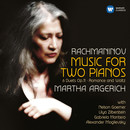
Rachmaninov: Music For Two Pianos
Martha ArgerichCD1
- Symphonic Dances Op. 45: I. Non allegro – Lento – Tempo I
- Symphonic Dances Op. 45: II. Andante con moto (Tempo di valse)
- Symphonic Dances Op. 45: III. Lento assai – Allegro vivace – Lento assai – Allegro vivace
- Suite No.1 in G minor Op.5 for two pianos: I. Barcarolle
- Suite No.1 in G minor Op.5 for two pianos: II. La Nuit… l’Amour
- Suite No.1 in G minor Op.5 for two pianos: III. Les Larmes
- Suite No.1 in G minor Op.5 for two pianos: IV. Pâques
- Suite No.2 Op.17 for two pianos: I. Introduction
- Suite No.2 Op.17 for two pianos: II. Valse
- Suite No.2 Op.17 for two pianos: III. Romance
- Suite No.2 Op.17 for two pianos: IV. Tarantella
CD2
- 6 Duets Op.11 for piano four hands: I. Barcarolle
- 6 Duets Op.11 for piano four hands: II. Scherzo
- 6 Duets Op.11 for piano four hands: III. Chanson russe
- 6 Duets Op.11 for piano four hands: IV. Valse
- 6 Duets Op.11 for piano four hands: V. Romance
- 6 Duets Op.11 for piano four hands: VI. Slava (Gloria)
- Romance in A
- Waltz in A
- Russian Rhapsody in E minor for two pianos: I. Moderato – Cadenza – Vivace – Meno mosso
- Russian Rhapsody in E minor for two pianos: II. Andante – Con moto – Tempo I (meno mosso)
Martha Argerich’s long career has taken in many outstanding solo performances, but she has often professed to feeling ‘lonely’ on stage. This CD showcases the area in which she feels truly at home: her extensive and fruitful collaborations with other first-class musicians. Among the many younger pianists she has taken under her wing at her academy in Lugano are Lilya Zilberstein, who rose to fame in the 1990s and whose sparkling playing is also featured on this disc, as well as Nelson
Goerner, whose collaboration with Argerich in Rachmaninov’s nostalgic Symphonic Dances is released here for the first time.
Did the barely twenty-year-old Rachmaninov have any inkling that, with his Suite No.1, Op.5, he had written one of his first masterpieces? Taking their lead, presumably, from the work’s dedication, commentators often remark on Tchaikovskyan influences which are, in reality, hard to discern. On the contrary, these four movements inspired by poems by Lermontov, Byron, Tyutchev and Khomyakov – brimming with colour and a flamboyant chromatic Romanticism which reaches its apogee in a Tristanesque nocturne centred around the notes of the nightingale’s song – sound so novel as to be entirely unprecedented in the history of Russian piano music. It was 1893, and Rachmaninov was exploring an even more unusual musical universe than that of Scriabin, then in search of his own voice and writing his second Sonata-Fantasy. However, when he heard the First Suite played in the US forty years later, Rachmaninov was somewhat harsh in his judgement of it, asking, in typically deadpan style, for its faults to be excused on the grounds of youth.
A year after writing the Suite No.1, the young composer conjured up more tableaux vivants with this new-found musical voice, producing the Six Duets for piano four hands, Op.11. It was almost a decade before Rachmaninov wrote for two pianos again. In November 1901, he and Siloti gave the premiere of the Second Suite before an incredulous Moscovite audience. The first theme makes a tremendous dynamic impact and is emblematic of this sunlit work, full of warm harmonies, building up to the dazzling Tarentelle (Presto) finale, an early forerunner of the Symphonic Dances. While meditative echoes of the contemporaneous Second Piano Concerto can be heard in the Romance, throughout the work as a whole the subtlety and assurance of the writing lifts the music beyond the two keyboards in search of the expressive diversity and eloquence of full orchestral forces. Rachmaninov’s final work, the aforementioned Symphonic Dances, was itself written for symphony orchestra, specifically the Philadelphia Orchestra under Eugene Ormandy, and was completed on 29 October 1940. At the same time he made a second version of the work, for two pianos – an arrangement for which the word reduction is inadequate, given how many of the orchestral timbres are reproduced almost identically within its framework.
Rachmaninov’s compositions for two pianos/piano four hands were overshadowed for years by his other piano works. The two suites were not recorded until the late 1930s, by Vitya Vronsky and Victor Babin (the composer’s own chosen performers). The lyrical rendering recorded in 1948 by Alexander Goldenweiser and Grigory Ginzburg, who also included Op.11, remained little known, even in the then USSR. Then, at last, in 1974, Vladimir Ashkenazy and André Previn set down their magnificent version, in glorious stereo.
Martha Argerich has been playing these works regularly since the 1980s. This is music she can share with her friends – she made a wonderful first recording of the Second Suite in 1982 with Nelson Freire – or with performers at the start of their careers: Nicolas Economou partnered her a year later with the creativity for which he was renowned in a characterful rendition of the Symphonic Dances. Only in September 1991 did Martha Argerich record both the two Suites and the Dances, with her colleague Alexandre Rabinovitch – a talented pianist, but first and foremost a composer, who created some stunning transcriptions for Argerich and himself, including a memorable reworking of Paul Dukas’s L’Apprenti sorcier.
Argerich still enjoys challenging partners as battle-hardened as she to perform these poetic, virtuoso works – and at times it’s a real high-wire act! Some will recall Akiko Ebi clinging for grim death to the keyboard in order to keep up with the devilish path blazed by Argerich. But the latter’s desire to share, and her natural interest in the talents of younger pianists, have led her to place this handful of works centre-stage at her Lugano academy. This album showcases the results gleaned between 2005 and 2009. The sense of shared purpose she achieves with Nelson Goerner in the Symphonic Dances results in a more dramatic reading: the constant allusions to the Dies irae are emphasised with greater intensity than in earlier performances, as if the studiously sombre tones and liquescent colours of Goerner’s touch, as well as his dense polyphony, have inspired Argerich herself to conceive a more inward-looking interpretation. Here, as elsewhere in these recordings, she is clearly listening closely to, and willingly complying with, suggestions made by her partner.
The alchemy created at Lugano flows in all directions. The Stelio Molo Auditorium is as much an ideas lab, an artists’ workshop, as it is a concert hall. Even when there seems to be perfect harmony – of rhythm, timbre, tempo – to the point of virtual unanimity, as in Argerich’s performance of the Second Suite with Gabriela Montero, certain key moments (in this case the surprising elongation of the great rallentando at the climax of the Introduction) remind us that anything is possible. Behind these partnerships there are often agreements to which each contributes just as much as the other. This is sometimes true of Akiko Ebi, and always of Lilya Zilberstein, who came close to stardom in the 1990s. After a triumphant debut, and having made a handful of albums for Deutsche Grammophon, each more magnificent than the one before, the young Russian pianist took some time away from the spotlight in order to bring up her two sons. She has always been passionate about Rachmaninov, and has all his piano works in her repertoire. No wonder, therefore, that she should bring to the First Suite an intense, poetic dimension, working in perfect symbiosis with Argerich’s own style – at once profound and feline. Rarely has that nightingale’s song been so moving, never has the heady peal of Easter bells whose firework display brings the work to a close sounded so crisp and clarion clear.
There is an equally magical sense of collaboration in the Six Duets, Op.11 – more modest in scope but, finely drawn as they are here, abounding in eloquence. Finally, it will come as no surprise to find Zilberstein inspiring Alexander Mogilevsky in the rarely performed Russian Rhapsody, and even less of one to hear her guiding her two boys, Daniel and Anton, in the delightful Romance and Waltz. After all, as far as Martha Argerich is concerned, Lugano is a family affair!