
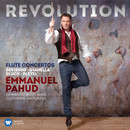
Revolution
Emmanuel Pahud- FRANCOIS DEVIENNE - Concerto No.7 in E minor: Allegro
- FRANCOIS DEVIENNE - Concerto No.7 in E minor: Adagio
- FRANCOIS DEVIENNE - Concerto No.7 in E minor: Rondo Allegretto
- LUIGI GIANELLA - Concerto No.1 in D minor: Allegro
- LUIGI GIANELLA - Concerto No.1 in D minor: Adagio
- LUIGI GIANELLA - Concerto No.1 in D minor: Allegro
- CHRISTOPH WILLIBALD GLUCK - Concerto in G major Opus 4: Allegro
- CHRISTOPH WILLIBALD GLUCK - Concerto in G major Opus 4: Adagio ma non troppo
- CHRISTOPH WILLIBALD GLUCK - Concerto in G major Opus 4: Presto
- IGNAZ PLEYEL - Concerto in C major B.106: Allegro
- IGNAZ PLEYEL - Concerto in C major B.106: Adagio
- IGNAZ PLEYEL - Concerto in C major B.106: Rondo: Allegro molto
Widely recognised as the finest flautist performing on the world stage today, Emmanuel Pahud has joined forces with the Kammerorchester Basel, led by Giovanni Antonini, to record a programme of music by composers from the time of the French Revolution. The disc, which brings together flute concertos by François Devienne, Luigi Gianella, Christoph Willibald Gluck and Ignaz Pleyel, reveals how rapidly the form evolved during this tumultuous period. Revolution follows the huge success
of The Flute King and Around the World.
The last years of the 18th century were not only a time of huge political upheaval across Europe but also a golden age of compositions for the flute, with the arrival in Paris of many foreign musicians, the rise of the phenomenon of the virtuoso and of public concerts attracting audiences from different social strata, the influences of the Enlightenment and of the Mannheim School and the newly-founded Paris Conservatoire serving as crucibles for creativity.
The French composer and virtuoso flautist and bassoonist François Devienne (1759-1803) settled in Paris in 1779. He played in several orchestras and became a professor of flute at the newly founded Conservatoire de Paris. Devienne wrote his Méthode de Flûte Théorique et Pratique in 1793 and composed many works for the instrument, including a dozen concertos, of which the Concerto No. 7 in E minor, composed around 1787, is considered the greatest. The work has contrasting lyrical passages and virtuoso episodes and is distinguished by its expressive richness and thematic variety.
We know little about the life of Luigi Gianella (c. 1778-1817), who was probably born in Italy. He settled in Paris in 1800 and was principal flute at several theatres. Gianella composed operas, ballets and numerous compositions for flute. His catalogue includes four flute concertos; the Concerto No. 1 in D minor was published by Pleyel in Paris around 1800. Gianella was a contemporary of Devienne but his music is more in the spirit of entertainment, the writing lighter and more carefree.
The German composer Christoph Willibald Gluck (1714-1787) was born many years before Devienne and Gianella and worked in Prague, Milan, Vienna and Paris. Gluck had strong links with Paris and played a pivotal role in the development of opéra-comique. His Concerto for Flute in G major, with an orchestra enriched by two horns, combines traditional forms with more modern elements. Given Gluck’s close relationships with the French royal family, it was probably just as well that he died in 1787 shortly before the flames of revolution spread throughout France.
The composer, publisher and piano builder Ignaz Pleyel (1757-1831), widely considered to be French, was actually born in Austria. Pleyel arrived in Paris in 1795, established the music publishing house, Chez Pleyel, there two years later and the piano manufacturing firm, Maison Pleyel, in 1807. His Concerto in C Major B.106 was originally composed for clarinet (1797) and appeared two years later in versions for flute and cello. The concerto is on a large scale and is characterised by musical influences from France, Czechoslovakia and Austria.
Like some of the performer-composers whose works appear on this recording, Emmanuel Pahud has travelled a great deal. Six weeks after he was born in Geneva in 1970, Emmanuel’s family moved to Baghdad for a year and then, in turn, to Paris, Madrid, Rome and Brussels. In Rome at the age of four, he was first enchanted by the sound of the flute. That Christmas, he received his first flute and began taking lessons. In due course, he graduated with the Premier Prix from the Conservatoire de Paris and, at the age of 22, he was invited to join the Berliner Philharmoniker as Principal Flute under Claudio Abbado, a position he still holds today. In addition to his engagements with the Berliner Philharmoniker, Emmanuel enjoys an extensive international career as soloist with the world’s leading orchestras and as a chamber musician, performing regularly with pianists Eric Le Sage, Yefim Bronfman and Hélène Grimaud, with jazz pianist Jacky Terrasson and with the wind ensemble Les Vents Français.
Since signing an exclusive contract in 1996 with EMI Classics, now under the Warner Classics umbrella, the only flautist in the world to have an exclusive contract with a major record label, Emmanuel Pahud has made or contributed to over 20 albums and is the natural successor to the great Jean-Pierre Rampal. As well as developing the contemporary flute repertoire by commissioning works from composers including Marc-André Dalbavie, Michael Jarrell, and Matthias Pintscher, Pahud equally enjoys going back to the golden age of the flute and exploring the Baroque and Classical masterpieces which form the bedrock of the flute canon. His recordings have won numerous awards. Most recently, he was named the 2014 Echo Klassik Instrumentalist of the Year (flute).