
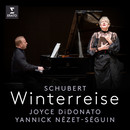
Schubert : Winterreise
Joyce DiDonato, Yannick Nezet-SeguinFranz Schubert (1797-1828): Winterreise D.911 (published as Op.89) (1827)
Texts: Wilhelm Müller (1794–1827) - Editions Bärenreiter
- Gute Nacht (Mässig) (D minor)
- Die Wetterfahne (Ziemlich geschwind) (A minor)
- Gefrorne Tränen (Nicht zu langsam) (F minor)
- Erstarrung (Ziemlich schnell) (C minor)
- Der Lindenbaum (Mässig) (E major)
- Wasserflut (Langsam) (E minor)
- Auf dem Flusse (Langsam) (E minor - 2nd version)
- Rückblick (Nicht zu geschwind) (G minor/G major)
- Irrlicht (Langsam) (B minor)
- Rast (Mässig) (C minor - 2nd version)
- Frühlingstraum (Etwas bewegt) (A major - 2nd version)
- Einsamkeit (Langsam) (B minor)
- Die Post (Etwas geschwind) (E-flat major)
- Der greise Kopf (Etwas langsam) (C minor)
- Die Krähe (Etwas langsam) (C minor)
- Letzte Hoffnung (Nicht zu geschwind) (E-flat major)
- Im Dorfe (Etwas langsam) (D major)
- Der stürmische Morgen (Ziemlich geschwind, doch kräftig) (D minor)
- Täuschung (Etwas geschwind) (A major)
- Der Wegweiser (Mässig) (G minor)
- Das Wirtshaus (Sehr langsam) (F major)
- Mut (Ziemlich geschwind, kräftig) (G minor/G major - 2nd version)
- Die Nebensonnen (Nicht zu langsam) (A major - 2nd version)
- Der Leiermann (Etwas langsam) (A minor)
World famous mezzo-soprano Joyce DiDonato and conductor-pianist Yannick Nézet-Séguin join forces to take on one of the most brilliant song cycles ever written: Schubert’s Winterreise (Winter Journey). DiDonato, however, casts a different light on this beloved cycle of 24 songs in telling their story from the perspective of the woman, the lost love. Nancy Plum, Town Topics writes: “The question of what happened to the woman who sent the narrator on a tortuous journey was not answered in the Wilhelm Müller poetry from which Schubert drew the text, but DiDonato created a scenario onstage of being that woman, reading from the narrator’s journal and responding to the inherent despair.”
New York Classical Review wrote about Joyce Didonato’s interpretation:
“…what stood out was the heavy emotion that came through in her singing, as she lingered on a syllable here, pressed her tone there. She created vivid feelings with her contrasts…”