
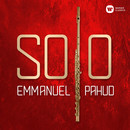
Solo
Emmanuel PahudCD1
- Toru Takemitsu (1930-1996): Air
- Georg Philipp Telemann (1681-1767): Fantasia No.1 in A major
- Sigfrid Karg-Elert (1877-1933): Sonata Appassionata, Op.140
- Georg Philipp Telemann: Fantasia No.2 in A minor
- Jörg Widmann (b.1973) : Petite Suite
- Georg Philipp Telemann: Fantasia No.3 in B minor
- Toru Takemitsu: Voice
- Georg Philipp Telemann: Fantasia No.4 in B flat major
- Robert Helps (1928-2001): Second Thoughts
- Georg Philipp Telemann: Fantasia No.5 in C major
- Arthur Honegger (1892-1955): Danse de la Chèvre
- Georg Philipp Telemann: Fantasia No.6 in D minor
- Matthias Pintscher (b.1971): Beyond (a system of passing)
CD2
- Pierre-Octave Ferroud (1900-1936): Bergère captive from Trois Pièces ('Oriental Pieces')
- Georg Philipp Telemann: Fantasia No.7 in D major
- Pierre-Octave Ferroud: Jade from Trois Pièces ('Oriental Pieces')
- Georg Philipp Telemann: Fantasia No.8 in E minor
- Carl Nielsen (1865-1931): The Children are Playing
- Georg Philipp Telemann: Fantasia No.9 in E major
- Pierre-Octave Ferroud: Toan-Yan (la Fête du Double Cinq) from Trois Pièces (Oriental Pieces)
- Georg Philipp Telemann: Fantasia No.10 in F sharp minor
- Luciano Berio (1925-2003): Sequenza I
- Georg Philipp Telemann: Fantasia No.11 in G major
- Arvo Pärt (b.1935): Estländler
- Georg Philipp Telemann: Fantasia No.12 in G minor
- Edgard Varèse (1883-1965): Density 21.5
- Marin Marais (1656-1728): Les Folies d’Espagne
The newest addition to Emmanuel Pahud’s substantial and wide-ranging Warner Classics catalogue is an imaginative collection of music for unaccompanied flute.
“The way I have ordered the pieces means that some of them echo across time, while others bounce off and respond to each other,” explains Pahud. “I find that alternating old and new music is enlightening on both sides. The listener needs to become quickly immersed in the programme, and this raises his or her awareness.”
Interweaving works from the Baroque era, the 20th century and the 21st century, Solo is threaded round Georg Philipp Telemann’s set of 12 fantasias, published in 1732-33. They are juxtaposed with music by composers of different eras: from the early and mid-20th century, Carl Nielsen, Arthur Honegger, Edgard Varèse and the lesser-known Pierre-Octave Ferroud and Sigfrid Karg-Elert; from the later 20th century, Luciano Berio, Toru Takemitsu and Robert Helps; and, from our own time, Arvo Pärt, Matthias Pintscher and Jörg Widmann. The programme concludes with Les Folies d’Espagne by a composer born 25 years before Telemann, Marin Marais.
“The flute - or any instrument, in fact – especially appeals to composers when an innovation offers them new technical and musical possibilities,” continues Pahud. “In the 18th century, the traverso flute was celebrated as a strong , powerful and expressive instrument, and it inspired such composers as Telemann, J.S. Bach , C.P.E. Bach and Marin Marais, who, making much use of dance rhythms, all aimed at making polyphonic music with a monodic instrument. The challenges for the performer lie in the breath control and in keeping the sound flexible and even across the range of the flute.
“Telemann’s 12 short pieces make a methodical journey through the 12 musical keys, in the manner of Bach‘s Well-Tempered Clavier or Paganini‘s caprices for violin. Telemann himself did not play the flute, so he offers even more challenges to the performer, not falling into the usual trap of simply creating effects with notes that lie well for the fingers.
“Towards the end of the 19th century, with the invention of the Boehm metal flute, composers discovered a whole new range of dynamic and expressive possibilities. Most of the pieces on this recording are about exploring new paths, in different directions or musical styles. The power of this music often lies in the contrast between a simple line and the most refined complexities, between a note so quiet as to be barely perceptible and the loudest, most extreme notes playable on the instrument. The evocative power of music like this is tremendous, and it is always fascinating to perform. Indeed, I regularly play purely solo flute recitals, but – whenever possible – I also like to include an unaccompanied piece in a regular recital or as an encore after a concerto.”
Pahud points out that technical innovations have continued to open up new possibilities for performers and composers. Since 2006, he has commissioned a new concerto on an annual basis, and both Matthias Pintscher’s Beyond (a system of passing) and Jörg Widmann’s Petite Suite, which feature in this collection, derive from the concertos they wrote for Pahud. “Ideally, these new works should belong to the future, and not just be tailor-made for me – I don’t like to interfere with the composer’s flow of inspiration. Composers should and do have their own processes and ideas when it comes to starting out on a piece. But, that being said, history has proven that encounters between composers and performers make these things happen!”