
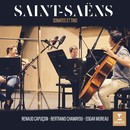
Saint-Saëns: Sonates et Trio
Renaud Capucon, Bertrand Chamayou, Edgar Moreau- Sonata for violin and piano No1 in D minor, Op.75 : I. Allegro agitato -
- Sonata for violin and piano No1 in D minor, Op.75 : Adagio
- Sonata for violin and piano No1 in D minor, Op.75 : II. Allegro moderato -
- Sonata for violin and piano No1 in D minor, Op.75 : Allegro molto
- Sonata for cello and piano No1 in C minor Op.32 : I. Allegro
- Sonata for cello and piano No1 in C minor Op.32 : II. Andante tranquillo sostenuto
- Sonata for cello and piano No1 in C minor Op.32 : III. Allegro moderato
- Trio for violin, cello and piano No2 in E Minor, Op.92 : I. Allegro non troppo
- Trio for violin, cello and piano No2 in E Minor, Op.92 : II. Allegretto
- Trio for violin, cello and piano No2 in E Minor, Op.92 : III. Andante con moto
- Trio for violin, cello and piano No2 in E Minor, Op.92 : IV. Grazioso, poco allegro
- Trio for violin, cello and piano No2 in E Minor, Op.92 : V. Allegro
2021 marks 100 years since the death of Camille Saint-Saëns, one of the acknowledged masters of French music. Born in Paris in 1835, he lived through a time of momentous change – in musical terms from the era of early Romanticism to the rise of Modernism – travelled widely around the world and enjoyed a distinguished career as an organist, pianist and, of course, composer.
Though Saint-Saëns’ output was prolific in a diversity of genres (he even wrote a film score in 1908), comparatively few of his works are performed with great frequency. This point is emphasised by the three musicians who collaborate on this album of chamber works: pianist Bertrand Chamayou, violinist Renaud Capuçon and cellist Edgar Moreau. In 2017 their collaboration on an Erato album of Debussy chamber music prompted BBC Music Magazine to note the “sense of joy in collegial music-making [that] pervades these performances”. For this Saint-Saëns album the programme comprises the Violin Sonata No 1, op 75 No 2 (composed in 1885), Cello Sonata No 1, op 32 No 1 (1872), and Piano Trio No 2, op 92 No 2 (1892).
“These are splendid works,” says Bertrand Chamayou, “but only relatively rarely performed and recorded. This is essential French Romantic chamber music and French performers of our generation have a duty to share it with audiences.”
Both Chamayou and Renaud Capuçon observe that Saint-Saëns‘ music is probably more popular outside France than in the country of the composer’s birth. “He’s a French composer par excellence,” says Capuçon … Perhaps that’s why his music is so popular abroad.” Chamayou wonders whether the situation might be a consequence of the composer’s long life. In his latter years, as composers like Debussy and Stravinsky rose to eminence in Paris, he perhaps gained a reputation for conservatism, but in the earlier stages of his career he had been a progressive figure, advocating such innovative composers as Liszt.
“There are flamboyant moments in Saint-Saëns’ works,” continues Chamayou, “but he remains Olympian, ‘above it all’ – he never lets himself go completely. He is an academic composer in the sense that he keeps to the rules and writes music that is very well made, but he is also rather like a dormant volcano, simmering away inside. And there is sensuality and quirkiness in his music – for instance in the ‘Egyptian’ Piano Concerto [No 5]. He was very prolific, so for this album we have chosen his most important chamber pieces. He might echo Beethoven, Schumann, Mendelssohn and Liszt, but he also has Gallic flair and there is an immediately recognisable personality in his melodies and harmonies.
“You can hear in his music that he was someone who had seen the world – within the disciplined framework there is space for archaic modes or oriental touches – but it is typically French in its clarity, transparency and limpidity. It also reflects the French language, which does not make use of heavy accentuation … It’s a language that reveals its richness and subtlety in a horizontal way, rather than through clearly defined blocks of words, keeping the listener ‘suspended’, in a kind of state of levitation.” Chamayou points out that this can also be sensed in the music of Fauré, who was mentored by Saint-Saëns, and of Ravel, who was Fauré’s student.
Edgar Moreau feels that “The craftsmanship of Saint-Saëns‘ music is very sophisticated – and it can also be technically challenging – but its appeal to the listener is direct and obvious. The musical language is Romantic, full of lyricism, contrasts and colour, and speaks to the audience very readily.”
In Renaud Capuçon’s view the Violin Sonata No 1 demonstrates just how well Saint-Saëns wrote for the instrument, which over the years has achieved currency with major violinists. Capuçon sees the work as evoking the salons of Paris in the Belle Époque, the Princesse de Polignac, a noted patron of the arts, and the ground-breaking novelist Marcel Proust. Indeed, it is possible that Saint-Saëns’ sonata was the inspiration for the violin sonata by the fictional composer Vinteuil, which plays a memorable role in the first volume of À la recherche du temps perdu. With the centenary of Proust’s death coming up in 2022, perhaps this album is paying tribute to one of France’s greatest writers as well as one of its greatest composers.