
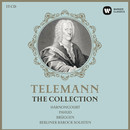
Telemann - The Collection (13CD)
Nikolaus Harnoncourt, Emmanuel Pahud, Frans BruggenCD1 OVERTURES (SUITES) I
- Overture for 3 oboes, bassoon, 2 violins, viola and b. c. in G minor: Ouverture (Grave · Allegro · Grave)
- Overture for 3 oboes, bassoon, 2 violins, viola and b. c. in G minor: Rondeau (Gayement)
- Overture for 3 oboes, bassoon, 2 violins, viola and b. c. in G minor: Les Irresoluts (à discrétion)
- Overture for 3 oboes, bassoon, 2 violins, viola and b. c. in G minor: Les Capricieux
- Overture for 3 oboes, bassoon, 2 violins, viola and b. c. in G minor: Loure
- Overture for 3 oboes, bassoon, 2 violins, viola and b. c. in G minor: Gasconnade
- Overture for 3 oboes, bassoon, 2 violins, viola and b. c. in G minor: Menuet I alternativement Menuet II
- Overture for 3 oboes, 2 violins, viola and b. c. in C major: Ouverture (Grave · Allegro · Allegro)
- Overture for 3 oboes, 2 violins, viola and b. c. in C major: Harlequinade
- Overture for 3 oboes, 2 violins, viola and b. c. in C major: Espagniol
- Overture for 3 oboes, 2 violins, viola and b. c. in C major: Bourrée en Trompette
- Overture for 3 oboes, 2 violins, viola and b. c. in C major: Sommeille
- Overture for 3 oboes, 2 violins, viola and b. c. in C major: Rondeau
- Overture for 3 oboes, 2 violins, viola and b. c. in C major: Menuet I alternativement Menuett II
- Overture for 3 oboes, 2 violins, viola and b. c. in C major: Gigue
- Overture for 3 oboes, bassoon, 2 violins, viola and b. c. in D minor: Ouverture (Grave · Allegro · Grave)
- Overture for 3 oboes, bassoon, 2 violins, viola and b. c. in D minor: Menuet I alternativement Menuet II
- Overture for 3 oboes, bassoon, 2 violins, viola and b. c. in D minor: Gavotte
- Overture for 3 oboes, bassoon, 2 violins, viola and b. c. in D minor: Courante
- Overture for 3 oboes, bassoon, 2 violins, viola and b. c. in D minor: Air
- Overture for 3 oboes, bassoon, 2 violins, viola and b. c. in D minor: Loure
- Overture for 3 oboes, bassoon, 2 violins, viola and b. c. in D minor: Hornpipe
- Overture for 3 oboes, bassoon, 2 violins, viola and b. c. in D minor: Canaries
- Overture for 3 oboes, bassoon, 2 violins, viola and b. c. in D minor: Gigue
CD2 OVERTURES (SUITES) II
- Overture for 3 oboes, 2 violons, viola and b. c. in D major: Ouverture
- Overture for 3 oboes, 2 violons, viola and b. c. in D major: Prélude (Très vite)
- Overture for 3 oboes, 2 violons, viola and b. c. in D major: Gigue
- Overture for 3 oboes, 2 violons, viola and b. c. in D major: Menuet I · Menuet II
- Overture for 3 oboes, 2 violons, viola and b. c. in D major: Harlequinade
- Overture for 3 oboes, 2 violons, viola and b. c. in D major: Loure
- Overture for 3 oboes, 2 violons, viola and b. c. in D major: Rondeau
- Overture for 3 oboes, 2 violons, viola and b. c. in D major: Réjouissance
- Overture for solo recorder, 2 violins, viola and b. c. in A minor: Ouverture
- Overture for solo recorder, 2 violins, viola and b. c. in A minor: Les Plaisirs
- Overture for solo recorder, 2 violins, viola and b. c. in A minor: Air à l’Italien
- Overture for solo recorder, 2 violins, viola and b. c. in A minor: Menuet I alternativement Menuet II
- Overture for solo recorder, 2 violins, viola and b. c. in A minor: Réjouissance
- Overture for solo recorder, 2 violins, viola and b. c. in A minor: Passepied I/II
- Overture for solo recorder, 2 violins, viola and b. c. in A minor: Polonaise
- Overture for 2 violins, viola, 2 recorders (Chaconne) and b. c. in F minor: Ouverture
- Overture for 2 violins, viola, 2 recorders (Chaconne) and b. c. in F minor: Menuet I alternativement Menuet II
- Overture for 2 violins, viola, 2 recorders (Chaconne) and b. c. in F minor: Rondeau
- Overture for 2 violins, viola, 2 recorders (Chaconne) and b. c. in F minor: Sarabande
- Overture for 2 violins, viola, 2 recorders (Chaconne) and b. c. in F minor: Passepied
- Overture for 2 violins, viola, 2 recorders (Chaconne) and b. c. in F minor: Plainte
- Overture for 2 violins, viola, 2 recorders (Chaconne) and b. c. in F minor: Allemande
- Overture for 2 violins, viola, 2 recorders (Chaconne) and b. c. in F minor: Chaconne
- Overture for 2 violins, viola, 2 recorders (Chaconne) and b. c. in F minor: Gigue
CD3 CONCERTOS I
- Concerto for recorder, bassoon, 2 violins, viola and b. c. in F major: Largo
- Concerto for recorder, bassoon, 2 violins, viola and b. c. in F major: Vivace
- Concerto for recorder, bassoon, 2 violins, viola and b. c. in F major: Grave
- Concerto for recorder, bassoon, 2 violins, viola and b. c. in F major: Allegro
- Concerto for 4 violins in G major: Largo et staccato
- Concerto for 4 violins in G major: Allegro
- Concerto for 4 violins in G major: Adagio
- Concerto for 4 violins in G major: Vivace
- Overture for 2 horns, 2 violins, and b. c. in F major: Ouverture (Lento · Allegro · Lento)
- Overture for 2 horns, 2 violins, and b. c. in F major: Rondeau
- Overture for 2 horns, 2 violins, and b. c. in F major: Saraband
- Overture for 2 horns, 2 violins, and b. c. in F major: Menuet
- Overture for 2 horns, 2 violins, and b. c. in F major: Boureé
- Concerto for 3 oboes, 3 violins and bass in B flat major: Allegro
- Concerto for 3 oboes, 3 violins and bass in B flat major: Largo
- Concerto for 3 oboes, 3 violins and bass in B flat major: Allegro
CD4 CONCERTOS II
- Concerto for flute, strings and b. c. in G major: Andante
- Concerto for flute, strings and b. c. in G major: Vivace
- Concerto for flute, strings and b. c. in G major: Adagio
- Concerto for flute, strings and b. c. in G major: Allegro
- Concerto For oboe, strings and b. c. in E minor: Andante
- Concerto For oboe, strings and b. c. in E minor: Allegro molto
- Concerto For oboe, strings and b. c. in E minor: Largo
- Concerto For oboe, strings and b. c. in E minor: Allegro
- Concerto for trumpet (orig. oboe), strings and b. c. in F minor: Allegro
- Concerto for trumpet (orig. oboe), strings and b. c. in F minor: Largo e piano
- Concerto for trumpet (orig. oboe), strings and b. c. in F minor: Vivace
- Concerto for 2 flutes, Violone, strings and b. c. in A minor: Lentement
- Concerto for 2 flutes, Violone, strings and b. c. in A minor: (No indication)
- Concerto for 2 flutes, Violone, strings and b. c. in A minor: Loure
- Concerto for 2 flutes, Violone, strings and b. c. in A minor: (Rondeau)
- Concerto for Flute, Oboe d’amore, Viola d’amore, strings and b. c. in E major: Andante
- Concerto for Flute, Oboe d’amore, Viola d’amore, strings and b. c. in E major: Allegro
- Concerto for Flute, Oboe d’amore, Viola d’amore, strings and b. c. in E major: Siciliano
- Concerto for Flute, Oboe d’amore, Viola d’amore, strings and b. c. in E major: Vivace
- Concerto for trumpet, 2 oboes, strings and b. c. in D major: Allegro
- Concerto for trumpet, 2 oboes, strings and b. c. in D major: Grave · Aria
- Concerto for trumpet, 2 oboes, strings and b. c. in D major: Vivace
CD5 CONCERTOS III
- Concerto for Oboe d'amore, strings and b. c. in E minor: (Allegro)
- Concerto for Oboe d'amore, strings and b. c. in E minor: (Andante)
- Concerto for Oboe d'amore, strings and b. c. in E minor: (Allegro)
- Concerto for viola, strings and b. c. in G major: Largo
- Concerto for viola, strings and b. c. in G major: Allegro
- Concerto for viola, strings and b. c. in G major: Andante
- Concerto for viola, strings and b. c. in G major: Presto
- Concerto for 2 violins, 2 horns, strings and b. c. in D major: Allegro
- Concerto for 2 violins, 2 horns, strings and b. c. in D major: Adagio
- Concerto for 2 violins, 2 horns, strings and b. c. in D major: Allegro
- Concerto for violin, strings and b. c. in A major "The Pond Frogs": Allegro
- Concerto for violin, strings and b. c. in A major "The Pond Frogs": Adagio
- Concerto for violin, strings and b. c. in A major "The Pond Frogs": Menuet-Alternativement
- Concerto for 2 violettas (violas), strings and b. c. in G major: Avec douceur
- Concerto for 2 violettas (violas), strings and b. c. in G major: Gay
- Concerto for 2 violettas (violas), strings and b. c. in G major: Largo
- Concerto for 2 violettas (violas), strings and b. c. in G major: Vivement
- Concerto for 2 violins, strings and b. c. in B flat major: Adagio
- Concerto for 2 violins, strings and b. c. in B flat major: Allegro
- Concerto for 2 violins, strings and b. c. in B flat major: Adagio
- Concerto for 2 violins, strings and b. c. in B flat major: Allegro
- Concerto for violin, strings and b. c. in G major: Andante
- Concerto for violin, strings and b. c. in G major: Allegro
- Concerto for violin, strings and b. c. in G major: Adagio
- Concerto for violin, strings and b. c. in G major: Presto
- Concerto for 2 horns, strings and b. c. in F major: (Adagio)
- Concerto for 2 horns, strings and b. c. in F major: Allegro
- Concerto for 2 horns, strings and b. c. in F major: Largo
- Concerto for 2 horns, strings and b. c. in F major: Vivace
CD6 TAFELMUSIC (EXCERPTS) I
- Overture for 2 flutes, strings and b. c. in E minor: Lentement · Vite · Lentement
- Overture for 2 flutes, strings and b. c. in E minor: Rejouissance
- Overture for 2 flutes, strings and b. c. in E minor: Rondeau
- Overture for 2 flutes, strings and b. c. in E minor: Loure
- Overture for 2 flutes, strings and b. c. in E minor: Passepied
- Overture for 2 flutes, strings and b. c. in E minor: Air, un peu vivement
- Overture for 2 flutes, strings and b. c. in E minor: Gigue
- Quartet for flute, oboe, violin and b. c. in G major: Largo · Allegro · Largo
- Quartet for flute, oboe, violin and b. c. in G major: Vivace · Moderato · Vivace
- Quartet for flute, oboe, violin and b. c. in G major: Grave
- Quartet for flute, oboe, violin and b. c. in G major: Vivace
- Concerto for flute, violin, Cello and b. c. in A major: Largo
- Concerto for flute, violin, Cello and b. c. in A major: Allegro
- Concerto for flute, violin, Cello and b. c. in A major: Grazioso
- Concerto for flute, violin, Cello and b. c. in A major: Allegro
CD7 TEFELMUSIC (EXCERPTS) II
- Trio Sonata for 2 violins and b. c. in E flat major: Affettuoso
- Trio Sonata for 2 violins and b. c. in E flat major: Vivace
- Trio Sonata for 2 violins and b. c. in E flat major: Grave
- Trio Sonata for 2 violins and b. c. in E flat major: Allegro
- Sonata for flute and b. c. in B minor: Cantabile
- Sonata for flute and b. c. in B minor: Allegro
- Sonata for flute and b. c. in B minor: Dolce
- Sonata for flute and b. c. in B minor: Allegro
- Conclusion for 2 flutes, strings and b. c. in E minor: Allegro · Largo · Allegro
- Overture and Suite for oboe, trumpet, strings and b. c. in D major: Ouverture (Lentement · Vite · Lentement)
- Overture and Suite for oboe, trumpet, strings and b. c. in D major: Air I (Tempo giusto)
- Overture and Suite for oboe, trumpet, strings and b. c. in D major: Air II (Vivace)
- Overture and Suite for oboe, trumpet, strings and b. c. in D major: Air III (Presto)
- Overture and Suite for oboe, trumpet, strings and b. c. in D major: Air IV (Allegro)
CD8 6 "PARIS" QUARTETS I
- Quartet No. 1 in D major: I. Prelude: Vivement
- Quartet No. 1 in D major: II. Tendrement
- Quartet No. 1 in D major: III. Vite
- Quartet No. 1 in D major: IV.Gaiment
- Quartet No. 1 in D major: V. Modérement
- Quartet No. 1 in D major: VI. Vite
- Quartet No. 2 in A minor: Allègrement
- Quartet No. 2 in A minor: Flatteusement
- Quartet No. 2 in A minor: Légèrement
- Quartet No. 2 in A minor: Un peu vitement
- Quartet No. 2 in A minor: Vite
- Quartet No. 2 in A minor: Coulant
- Quartet No. 3 in G major: Prélude
- Quartet No. 3 in G major: Légèrement
- Quartet No. 3 in G major: Gracieusement
- Quartet No. 3 in G major: Vite
- Quartet No. 3 in G major: Modéré
- Quartet No. 3 in G major: Gai
- Quartet No. 3 in G major: Lentement
CD9 6 "PARIS" QUARTETS II
- Quartet No. 4 in B minor: Prélude
- Quartet No. 4 in B minor: Coulant
- Quartet No. 4 in B minor: Gai
- Quartet No. 4 in B minor: Vite
- Quartet No. 4 in B minor: Triste
- Quartet No. 4 in B minor: Menuet, Modéré
- Quartet No. 5 in A major: Prélude: Vivement
- Quartet No. 5 in A major: Gai
- Quartet No. 5 in A major: Modéré
- Quartet No. 5 in A major: Modéré
- Quartet No. 5 in A major: Pas vite
- Quartet No. 6 in E minor: Prélude
- Quartet No. 6 in E minor: Gai
- Quartet No. 6 in E minor: Vite
- Quartet No. 6 in E minor: Gracieusement
- Quartet No. 6 in E minor: Distrait
- Quartet No. 6 in E minor: Modéré
CD10 SONATAS AND QUARTETS
- Trio Sonata for recorder, violin and b. c. in A minor: Largo
- Trio Sonata for recorder, violin and b. c. in A minor: Vivace
- Trio Sonata for recorder, violin and b. c. in A minor: Affetuoso
- Trio Sonata for recorder, violin and b. c. in A minor: Allegro
- Trio Sonata for recorder, oboe and b. c. in F major: Largo
- Trio Sonata for recorder, oboe and b. c. in F major: Allegro
- Trio Sonata for recorder, oboe and b. c. in F major: Largo
- Trio Sonata for recorder, oboe and b. c. in F major: Allegro
- Trio Sonata for recorder, pardessus de viole and b. c. in D minor: Andante
- Trio Sonata for recorder, pardessus de viole and b. c. in D minor: Vivace
- Trio Sonata for recorder, pardessus de viole and b. c. in D minor: Adagio
- Trio Sonata for recorder, pardessus de viole and b. c. in D minor: Allegro
- Sonata for recorder and violin piccolo in B flat major: Dolce
- Sonata for recorder and violin piccolo in B flat major: Scherzando
- Sonata for recorder and violin piccolo in B flat major: Largo e misurato
- Sonata for recorder and violin piccolo in B flat major: Vivace e staccato
- Quartet for recorder, violin, viola and b.c in G minor: Allegro
- Quartet for recorder, violin, viola and b.c in G minor: Adagio
- Quartet for recorder, violin, viola and b.c in G minor: Allegro
- Trio Sonata for recorder, oboe and b. c. in E minor: Affetuoso
- Trio Sonata for recorder, oboe and b. c. in E minor: Allegro
- Trio Sonata for recorder, oboe and b. c. in E minor: Grave
- Trio Sonata for recorder, oboe and b. c. in E minor: Allegro
- Quartet for recorder, oboe, violin and b. c. in G major: Allegro
- Quartet for recorder, oboe, violin and b. c. in G major: Grave
- Quartet for recorder, oboe, violin and b. c. in G major: Allegro
CD11 VOCAL WORKS I
- The Day of Judgement - Die erste Betrachtung: Einleitung
- The Day of Judgement - Die erste Betrachtung: Coro: "Der Herr kommt mit vieltausend Heiligen"
- The Day of Judgement - Die erste Betrachtung: Recitativo (Basso): "Ruft immerhin, des Pöbels Wut zu zähmen"
- The Day of Judgement - Die erste Betrachtung: Aria (Basso): "Fürchtet nur, fürchtet des Donnerers Schelten"
- The Day of Judgement - Die erste Betrachtung: Recitativo (Basso, Soprano, Tenore): "Wer ist, der kühn sein Joch zerreißt?"
- The Day of Judgement - Die erste Betrachtung: Aria (Tenore): "Jetzt weiss ich's, überkluge Köpfe"
- The Day of Judgement - Die erste Betrachtung: Recitativo (Alto): "Genug der Schande bloßgestellt"
- The Day of Judgement - Die erste Betrachtung: Aria (Alto): "Des Sturmes Donnerstimmen schallen"
- The Day of Judgement - Die erste Betrachtung: Recitativo (Soprano) "Ganz recht, das Endliche vergeht"
- The Day of Judgement - Die erste Betrachtung: Coro: "Dann jauchzet der Gerechten Same"
- The Day of Judgement - Die zweite Betrachtung: Coro: "Es rauscht"
- The Day of Judgement - Die zweite Betrachtung: Recitativo accompagnato (Basso): "Da sind sie, der Verwüstung Zeichen!
- The Day of Judgement - Die zweite Betrachtung: Aria (Basso). "Da kreuzen verzehrende Blitze"
- The Day of Judgement - Die zweite Betrachtung: Recitativo (Tenore): "Gewaltig Element!"
- The Day of Judgement - Die zweite Betrachtung: Arioso (Soprano): "Ich aber schwinge mich empor"
- The Day of Judgement - Die dritte Betrachtung: Recitativo accompagnato (Alto): "Ich sehe, Gott, den Engel deiner Rache!"
- The Day of Judgement - Die dritte Betrachtung: Arioso (Tenore): "So spricht der Herr, der mich gesandt"
- The Day of Judgement - Die dritte Betrachtung: Recitativo (Alto): "Nun dränget sich der Kreis der ganzen Erde"
- The Day of Judgement - Die dritte Betrachtung: Aria (Basso): "Seid mir gesegnet, ihr Gerechten"
- The Day of Judgement - Die dritte Betrachtung: Corale: "Du, Ehren König, Jesu Christ"
- The Day of Judgement - Die dritte Betrachtung: Recitativo (Tenore): "Da sitzet Er – o wie nenn' ich ihn"
- The Day of Judgement - Die dritte Betrachtung: Coro: "Ach Hilfe! Weh uns! Hilfe! Rat!"
- The Day of Judgement - Die dritte Betrachtung: Recitativo (Tenore): "Wir flehn umsonst. – Der Tod entweicht!
- The Day of Judgement - Die dritte Betrachtung: Aria (Basso): "Hinweg von meinem Angesichte"
CD12 VOCAL WORKS II
- The Day of Judgement - Die vierte Betrachtung: Coro: "Schallt, ihr hohen Jubellieder!"
- The Day of Judgement - Die vierte Betrachtung: Arioso (Basso): "Nun ist das Heil und die Kraft"
- The Day of Judgement - Die vierte Betrachtung: Arioso (Tenore): "Ein ew'ger Palm umschlingt mein Haar"
- The Day of Judgement - Die vierte Betrachtung: Coro: " Heilig ist unser Gott!"
- The Day of Judgement - Die vierte Betrachtung: Arioso (Alto): "Heil! Wenn um des Erwürgten willen"
- The Day of Judgement - Die vierte Betrachtung: Arioso (Basso, Coro): "Das Lamm, das erwürget ist"
- The Day of Judgement - Die vierte Betrachtung: Aria (Soprano): "Ich bin erwacht nach Gottes Bilde"
- The Day of Judgement - Die vierte Betrachtung: Coro: " Lobt ihn, ihr Seraphinen-Chöre!"
- The Day of Judgement - Die vierte Betrachtung: Recitativo (Alto): "Es ist geschehen! die Tugend ist gerächt!"
- The Day of Judgement - Die vierte Betrachtung: Coro: "Die Rechte des Herrn ist erhöhet!"
- Ino: Recitativo: "Wohin! wo soll ich hin?"
- Ino: Aria: "Ungöttliche Saturnia"
- Ino: Recitativo: "O all ihr Mächte des Olympus"
- Ino: Larghetto: "Wo bin ich?"
- Ino: Vivace con molto affetto: "Ich seh' ihn!"
- Ino: Tanz der Tritonen: Allegramente · Vivace spirituoso e con affetto
- Ino: Recitativo: "Ungewohnte Symphonien"
- Ino: Aria: "Meint ihr mich, Ihr Nereiden?"
- Ino: Recitativo: "Und nun! Ihr wendet euch"
- Ino: Aria: "Tönt in meinem Lobgesang"
CD13 VOCAL WORKS III
- Pimpinone - Intermezzo I: Aria (Vespetta): "Chi mi vuol, son cameriera"
- Pimpinone - Intermezzo I: Recitativo (Vespetta): "Ich suche zwar ein Glück"
- Pimpinone - Intermezzo I: Aria (Vespetta): "Höflich reden, lieblich singen"
- Pimpinone - Intermezzo I: Recitativo:(Pimpinone): "Doch was kann dieses wohl für Lust erwecken?"
- Pimpinone - Intermezzo I: Aria (Pimpinone): "Ella mi viol confondere"
- Pimpinone - Intermezzo I: Recitativo (Pimpinone): "Was aber denkt ihr nun zu thun"
- Pimpinone - Intermezzo I: Aria (Duett, Pimpinone/Vespetta): "Nell petto il cor mi giubila"
- Pimpinone - Intermezzo II: Recitativo (Pimpinone): "Vespetta, willst Du von mir gehen?"
- Pimpinone - Intermezzo II: Aria (Vespetta): "Nei brevi momenti"
- Pimpinone - Intermezzo II: Recitativo (Pimpinone): "Schweig, schweig! Du hast ja alles recht gemacht"
- Pimpinone - Intermezzo II: Aria (Pimpinone): "Guarda un poco"
- Pimpinone - Intermezzo II: Recitativo (Vespetta): "Er schweige nur!"
- Pimpinone - Intermezzo II: Aria (Vespetta): "Io non sono una di quelle"
- Pimpinone - Intermezzo II: Recitativo (Pimpinone): "So geht es gut"
- Pimpinone - Intermezzo II: Aria (Pimpinone): Stendi, stendi! Uh! ch'allegrezza!
- Pimpinone - Intermezzo III: Recitativo (Vespetta): "Ich will dahin, wo es mir beliebet, gehen"
- Pimpinone - Intermezzo III: Recitativo (Pimpinone): "So quel che si dice"
- Pimpinone - Intermezzo III: Recitativo (Pimpinone): "Für dieses Mal"
- Pimpinone - Intermezzo III: Aria (Vespetta): "Voglio far come fan l'altre"
- Pimpinone - Intermezzo III: Recitativo (Pimpinone): "Wie aber, wenn ich's auch so machen wollte?"
- Pimpinone - Intermezzo III: Aria (Duett, Pimpinone/Vespetta): "Wilde Hummel! böser Engel!"
- Pimpinone - Intermezzo III: Recitativo (Vespetta): "Du eigensinn'ger Esel"
- Pimpinone - Intermezzo III: Aria (Duett, Vespetta/ Pimpinone): "Schweig hinkünftig, albrer Tropf!"
“This famous man is one of the three master musicians who are nowadays such a credit to our homeland. Hendel [sic] is admired by all connoisseurs in London, and Kapellmeister Bach is the head of his clan in Saxony.” The first of these three composers was Georg Philipp Telemann, who in his day was director of music in Hamburg, head of the city’s Theater am Gänsemarkt and cantor at the Johanneum. These lines were written in 1728 by Johann Christoph Gottsched, one of the leading men of letters of his day. A century later it would have been unthinkable for any writer to accord Telemann such a status.
Fame and posthumous reputation have always been two distinct entities, but few composers have seen their reputation so comprehensively demolished as was the case with Telemann. He was eighty-six when he died in 1767. With the passage of time his works were performed less and less, and the more uninhibited later generations became in dismissing him. But what were their reasons for doing so? And what was the connection between veneration and condemnation?
Telemann’s list of surviving works runs to more than 3,600 titles, making it seem almost as if his reputation was a natural consequence of this prolificacy. Even as a child he was already accompanied by an aura of precocity, although his family did what they could to discourage his passion for music since musicians were held in the lowest social esteem. “I’d become a travelling entertainer, a tightrope walker, a minstrel or a marmot trainer if music were not taken away from me,” Telemann recalled the nay-sayers’ admonishments in his native Magdeburg.
Their admonishments were futile. In Leipzig, where Telemann’s family decreed that he should study law, he met Bach. Here, too, his abilities were quickly recognized and, barely twenty-three, he was appointed organist and music director of the Neukirche, an appointment that spelt the end of his future as a lawyer. And yet he did not remain for long in Leipzig as one attractive job offer followed another with remarkable frequency. Some of them he even accepted. Above all, he proved adept at playing off the many offers and honorary titles whenever it was a question of raising his salary. When he took up his new position in Hamburg in 1721, his name was known throughout the whole of Europe. He remained loyal to the city until his death in 1767.
Contemporaries were familiar not only with Telemann’s name but also, of course, with his music. More than forty of his works were privately printed. At this period it was exceptional for music to be published at all, for it was mostly written for special occasions and was never performed again. But for his Musique de table Telemann received subscriptions not only from Germany but also from Spain, Italy, France and even Norway.
Telemann himself was an early European – stylistically, too. Even while he was a student, he was introduced to the music of Lully and Campra, two composers associated with the court at Versailles, and as a result he developed a love for French music. He was also familiar with the cantabile elegance of composers such as Corelli and Caldara and was especially fond of Polish folk music, which at that time was known in Germany only in the vaguest outline. Time and again he returned to its “true barbaric beauty”: “It is hard to credit the wonderful ideas that these bagpipe players and fiddlers have when they improvise.” In spite of this, Telemann did not simply imitate national styles but fused them together to create something uniquely his own, something that his contemporaries called a “mixed style”. Today it sounds like a political statement, but to the artists of the 18th century it was an aesthetic concern first and foremost.
What was it that attracted listeners to Telemann’s music? His music is based on the formal language of the Baroque, while at the same time pointing the way forward to the Age of Sensibility and its galant volatility. Telemann was able to express in his music not only human emotions but also external events such as the murmuring of a brook or the bustle of the port of Hamburg. His melodic writing is as imaginative as it is immediately affecting. “Singing is the foundation of music in every respect” was Telemann’s musical credo. He was never concerned with virtuosity as an end in itself.
His penchant for comedy is legendary. Take Pimpinone, an intermezzo first performed at Hamburg’s Theater am Gänsemarkt in 1725. In a monologue, the tormented husband imitates the voices of two cantankerous women in falsetto, adding personal comments and asides in his normal bass register. Pimpinone is an example of Telemann’s detailed interest in Italian music, and this remains true whether or not the piece is entirely his or whether he took over sections from a comic intermezzo by Tomaso Albinoni, who had set the same libretto – a process that Telemann’s contemporaries did not regard as intellectual theft but as a compliment paid to the original composer.
Telemann’s creativity never waned. He wrote operas and songs, overtures and chamber music, organ works, motets and oratorios and even a Cantata or Funeral Music for an Artistically Gifted Canary Whose Demise Caused its Master the Greatest Sorrow. In 1728, when he was forty-seven, he wrote that he could more or less rely on the fact that “the notes have until now sought me out almost as soon as I cast round for them”. It was a facility that remained with him until his old age. Inquisitive about every musical development, he wrote bold harmonies that left even his younger colleagues feeling bewildered.
Telemann’s death marked a turning point in the reception of his music. While his contemporaries had acclaimed him as one of the leading composers in Europe with an “inexhaustible” fund of ideas, his works were increasingly rarely performed in the wake of his death, and by the beginning of the 19th century his music had been forgotten – so much so that even experts would excoriate his music without ever having heard a note of it.
Criticism of Telemann can be summed up in a single phrase: he was reproached for not being Bach. Indeed, he was held out as the diametrical opposite of the Thomaskantor, who was increasingly idolized following Mendelssohn’s revival of the St Matthew Passion in 1829. Bach’s biographer Philipp Spitta drew an exaggerated distinction between the profound and austerely uncompromising Thomaskantor on the one hand and the pleasantly complaisant and prolific Telemann on the other, and other writers on music were only too pleased to follow his lead. It occurred to no one that any output of such vast dimensions is bound to include less inspired pieces, a point that is true even for Bach. All that his contemporaries admired about Telemann was now turned against him, and many of the indictments of his music contained – either openly or as a subtext – the reproach that his music was “un-German”, an attribute that was to point the way forward to a particularly dark period in German musicology. As if Bach himself had not assimilated the manifold musical currents of his own day!
How different it was while Telemann was still alive! The two composers were on friendly terms and held each other in high esteem. Bach often performed Telemann’s works in Leipzig and owned copies of many of his friend’s scores, with the result that researchers even ascribed some of them to Bach and acclaimed them accordingly. Once the error had been exposed, however, they then proceeded to dismiss those same works as “banal” or as “guilty of hankering after empty effects”.
Telemann’s more recent biographer, Eckart Kleßmann, has drawn attention to the contradictions that have long bedevilled the reception of the composer’s music and shown that even at the end of the 20th century commentators were still expressing reservations about it. Even today many listeners continue to associate Telemann’s name with indifferently performed recorder concertos – in spite of the fact that his rehabilitation began some time ago: two of the works that he wrote towards the end of his life, Der Tag des Gerichts and Ino, were both published in 1907 as part of the series Denkmäler deutscher Tonkunst (Monuments of German Music), according them a belated patent of nobility.
If the Telemann revival gathered pace in the course of the following decades, then this was due in no small part to the early music movement: countless musicians – most notably Nikolaus Harnoncourt – set out on a voyage of discovery that took them to a largely unknown continent, finally doing justice to this intelligent and life-affirming music through the ebullience and vitality of their performances, qualities based in turn on their appreciation of the need for a specific intonation, phrasing and articulation. Only in this way can Telemann’s music reveal its effectiveness. And only in this way does the composer have a chance to emerge from the niche markets of specialized festivals and enter the repertory of middle-class concert halls, where Bach and Handel have long since enjoyed their rightful place.