
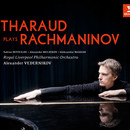
Tharaud Plays Rachmaninov
Alexandre Tharaud, Royal Liverpool Philarmonic OrchestraLPA
- Piano Concerto No.2 in C minor Op. 18 (1901) - Moderato
- Piano Concerto No.2 in C minor Op. 18 (1901) - Adagio sostenuto
- Piano Concerto No.2 in C minor Op. 18 (1901) - Allegro scherzando
- Morceaux de fantaisie Op.3 (1892) - Élégie en Mi bémol mineur
- Morceaux de fantaisie Op.3 (1892) - Prélude en Do dièse mineur
- Morceaux de fantaisie Op.3 (1892) - Mélodie en Mi majeur
LPB
- Morceaux de fantaisie Op.3 (1892) - Polichinelle
- Morceaux de fantaisie Op.3 (1892) - Sérénade
- Vocalise Op. 34 No.14 (1915)
- Two Pieces for Piano, 6 Hands (1890–91) - Romance in A Major / Andante sostenuto
- Two Pieces for Piano, 6 Hands (1890–91) - Valse in A Major / Tempo di Valse. Allegro
Alexandre Tharaud’s recorded catalogue is large and eclectic, but this is the first time he has devoted an entire album to Russian repertoire – specifically to the music of Sergei Rachmaninov.
The composer’s famous C sharp minor prelude featured on Autograph, the recital CD Tharaud released in 2013. This new album contains a work that is even more widely loved, the Piano Concerto No. 2 in C minor. The French pianist is partnered by the Royal Liverpool Philharmonic Orchestra, which over the last ten years has reached new heights under its Russian Principal Conductor, Vasily Petrenko. For this recording, another major Russian conductor was in charge, Alexander Vedernikov, formerly Music Director and Chief Conductor of Moscow’s Bolshoi Theatre and described by Tharaud as “perhaps one of today's greatest Rachmaninov specialists”.
“I was still quite young when I first played this concerto,” explains Tharaud. “I adored it … Rachmaninov’s virtuosity really appeals to young pianists. Today, of course I’m still enthralled by the concerto’s virtuosity, but now I’m more interested in its dark shadows: the sense of despair, of staring into the abyss. My interpretation of Rachmaninov has changed a lot over the years.”
“The concerto was written in 1900, exactly at the turn of the century. It was an important year for Rachmaninov because he was coming out of a dark period, a depression. He underwent treatment with hypnosis, but writing this concerto must surely have helped him emerge from that depression. Rachmaninov was reborn with this work … It really is a supreme masterpiece, a real milestone in the life of the composer, and can be seen as dividing his career into two halves. It marks both the turn of the century and a fresh start for Rachmaninov.”
The disc brings Alexandre Tharaud together with three Slavic musicians who share his forename: not only the conductor Alexander Vedernikov, but also two pianists, the Serbian Alexander Madžar and the Russian Alexander Melnikov. The three pianists gathered at one keyboard to record two relatively rarely-heard pieces for six hands, both in the key of A major and written nearly a decade before the Concerto No 2: a Romance – which bears a close resemblance to the much-loved Adagio of the Concerto No. 2 – and a Valse.
Dating from a similar period are the solo Morceaux de fantaisie, which Tharaud describes as “character pieces that are clearly precursors to the concerto”. They are again in keeping with the style and spirit of the concerto with their “mixture of vehement forcefulness and incredible tenderness, brought to life by a highly creative imagination”.
Another guest appearance – by the young French soprano Sabine Devieilhe – completes the album. She joins Tharaud for a performance of the gorgeous wordless Vocalise. This is another of Rachmaninov’s best-known works, but only comparatively rarely has it been recorded, as here, in its original version for voice and piano. Tharaud speaks of its “ethereal and timeless quality. It is a work you often hear with very big voices, and I needed a more fluid, more crystalline timbre.” Devieilhe, whose repertoire includes the music of Rameau and such high-flying operatic roles as Delibes’ Lakmé and Mozart’s Queen of the Night, provides an exquisite, subtly sensuous vocal line.