
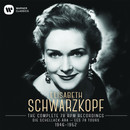
The Complete 78 Rpm Recordings
Elisabeth SchwarzkopfCD1
- Mozart: Die Entführung aus dem Serail: Martern aller Arten
- Mozart: Die Zauberflöte: Bei Männern, welche Liebe fühlen
- Strauss: Der Rosenkavalier: Herr Gott im Himmel
- Brahms: Ein deutsches Requiem, Op.45: Ihr habt nun Traurigkeit
- Puccini: La Bohème: Sì, mi chiamano Mimì
- Puccini: Gianni Schicchi: O mio babbino caro
- Puccini: Turandot: Tu che di gel sei cinta
- Gruber: Stille Nacht
- Traditional: O Tannenbaum
- Traditional: O du fröhliche, o du selige
- Traditional: Es ist ein Ros entsprungen
- Schubert: Seligkeit
- Schubert: Die Forelle, D550
- Dowland: Come again! sweet love doth now invite
- Arne: When daisies pied
- Morley: It was a lover and his lass
CD2
- Mozart: Il re pastore: L’amerò, sarò costante
- Handel: L’allegro, il penseroso ed il moderato: First and chief on golden wing ... Sweet bird
- Mozart: Exsultate, jubilate, K165
- Strauss: Frühlingsstimmen, Op.410: Part 1
- Mozart: Die Entführung aus dem Serail: Welcher Kummer ... Traurigkeit
- Mozart: Don Giovanni: In quali eccessi ... Mi tradì quell’alma ingrata
- Humperdinck: Hänsel und Gretel: Suse, liebe Suse ... Brüderchen (Tanzduett)
- Humperdinck: Hänsel und Gretel: Der kleine Sandmann bin ich (Sandman’s Song)
- Humperdinck: Hänsel und Gretel: Abends will ich schlafen geh’n (Evening Prayer)
- Mozart: Die Zauberflöte: Ach, ich fühl’s (sung in English)
- Verdi: La traviata: È strano! ... Ah, fors’è lui (sung in English)
CD3
- Mozart: Exsultate, jubilate, K165
- Bach: Jauchzet Gott in allen Landen, BWV 51
- Charpentier: Louise: Depuis le jour
- Puccini: La Bohème: Donde lieta uscì
- Puccini: Turandot: Signore ascolta
- Puccini: Madama Butterfly: Un bel dì vedremo
- Verdi: La traviata: Addio del passato
- Beethoven: Fidelio: Ach wär’ ich schon
- Bizet: Carmen: Je dis que rien ne m’épouvante
- Wagner: Tristan und Isolde: Tot denn alles!
- Gruber: Silent Night, Holy Night (arr. Lionel Salter)
- Traditional: The First Nowell (arr. Lionel Salter)
CD4
- Medtner: The Rose, Op.29 No.6
- Medtner: When roses fade, Op.36 No.3
- Medtner: Im Vorübergehn, Op.6 No.4
- Medtner: Elfenliedchen, Op.6 No.3
- Medtner: Meeresstille, Op.15 No.7
- Medtner: Glückliche Fahrt, Op.15 No.8
- Medtner: Die Quelle, Op.46 No.6
- Medtner: Selbstbetrug, Op.15 No.3
- Medtner: The Muse, Op.29 No.1
- Medtner: So tanzet, Op.15 No.5
- Medtner: The Waltz, Op.32 No.5
- Medtner: Einsamkeit, Op.18 No.3
- Medtner: Praeludium, Op.46 No.1
- Medtner: Winternacht, Op.46 No.5
- Mozart: Warnung, K433/K416c
- Arne: When daisies pied
- Arne: Where the bee sucks
- Traditional: Gsätzli
- Traditional: Die Beruhigte
- Traditional: O du liebs Ängeli
- Traditional: Maria auf dem Berge
- Schumann: Der Nussbaum, Op.25 No.3
- Schumann: Aufträge, Op.77 No.5
- Mozart: Der Zauberer, K472
- Brahms: Da unten im Tale, WoO 33 No.6
- Stolzel: Bist du bei mir, BWV 508
- Mozart: Abendempfindung, K523
- Wolf: Wiegenlied im Sommer
- Wolf: Mausfallensprüchlein
CD5
- Bach/Gounod: Ave Maria
- Schubert: Die Vögel, D691
- Schubert: Liebhaber in allen Gestalten, D558
- Mozart: Das Veilchen, K476
- Wolf: Storchenbotschaft
- Schubert: Gretchen am Spinnrade, D118
- Wolf: Epiphanias
- Wolf: Mein Liebster hat zu Tische
- Wolf: Du denkst mit einem Fädchen
- Wolf: Schweig’ einmal still
- Wolf: Wiegenlied im Sommer
- Wolf: Im Frühling
- Wolf: Storchenbotschaft
- Wolf: Elfenlied
- Wolf: Nixe Binsefuß
- Wolf: Bedeckt mich mit Blumen
- Wolf: Mögen alle bösen Zungen
- Wolf: Mausfallensprüchlein
- Wolf: Wer tat deinem Füßlein weh?
- Wolf: Die Spröde
- Wolf: Die Bekehrte
- Strauss: Hat gesagt bleibt’s nicht dabei, Op.36 No.3
- Strauss: Schlechtes Wetter, Op.69 No.5
- Schubert: Der Musensohn, D764
- Schubert: Wiegenlied, D498
- Brahms: Och Mod’r, ich well en Ding han, WoO 33 No.33
- Brahms: Vergebliches Ständchen, Op.84 No.4
- Wolf: In dem Schatten meiner Locken
Elisabeth Schwarzkopf · The Complete 78 rpm Recordings, a 5-CD collection of recordings made between 1946 and 1952, follows and complements the 31-CD set, Elisabeth Schwarzkopf – The Complete Recitals 1952-1974, which was released in Autumn 2015 to mark the 100th anniversary of the soprano’s birth.
Schwarzkopf was one of the reigning sopranos of the second half of the 20th century and her recordings are timeless treasures of the Warner Classics catalogue. Like her contemporary and friend, Maria Callas, she represents a golden era of recording.
Schwarzkopf re-recorded a number of the items later in her career. Her maturity brought greater vocal richness and still more interpretative insight, but these recordings from the 78 era – and the years which saw her establish a major international reputation – show her voice and artistry at their freshest.
In 1946, the German-born singer was making a career in Vienna – she had joined the company of the Staatsoper in 1942. The British record producer Walter Legge visited the Austrian capital to establish contact with Herbert von Karajan and to scout out new talent. He heard Schwarzkopf at the Theater an der Wien in Rossini’s II barbiere di Siviglia, and judged that she had ‘a brilliant fresh voice shot with laughter … admirably projected with enchanting high pianissimo’. Karajan recommended her to him as “potentially the best singer we have”. Schwarzkopf auditioned for Legge and her recording career for HMV/EMI was launched with sessions in the famous Musikverein for ‘Martern aller arten’ from Mozart’s Die Entführung aus dem Serail.
That meeting between Schwarzkopf and Legge launched an important professional and personal relationship that was to be central to the soprano’s career. Every track in this collection was produced by Legge and in 1953 he became Schwarzkopf’s husband. As the British music critic Edward Greenfield – who knew Elisabeth Schwarzkopf well – wrote in Gramophone in 1976: “If Elisabeth Schwarzkopf has established herself as a positive artist of unrivalled magnetism, she is the first to attribute to Walter Legge a dominant share in that success. ‘If I say I’m His Master’s Voice, people think I’m joking,’ she says, ‘but I’m not’. That first audition [in Vienna] proved at the very start that Schwarzkopf’s firm will could stand up to Legge’s insistence, that her all-demanding artistic standards could blossom from the most searching scrutiny, that their talents, and indeed their strong and vital personalities, were complementary.”
The songs of Hugo Wolf were one of Legge’s musical passions and Schwarzkopf became a supreme interpreter of his songs. 19 of them feature on this set, as do songs by Mozart, Schubert, Schumann, Brahms, Strauss, the Russian composer Nicolai Medtner (14 in all, accompanied by Medtner himself) and the English composers John Dowland, Thomas Morley and Thomas Arne. A number of traditional songs are also included, among them the Swiss ditty ‘Gsätzli’, closely identified with Schwarzkopf. The collection also features numbers from sacred works by Bach, Brahms and Mozart, Handel’s secular ode L'allegro, il penseroso ed il moderato and Johann Strauss’s Frühlingsstimmen
In 1947 Schwarzkopf joined the opera company at Covent Garden in London, where she remained for four seasons. Later in her career she restricted her stage appearances in opera to the roles of Mozart’s Donna Elvira and Strauss’s Marschallin, but as a young singer, initially making her reputation in Berlin and Vienna as a lyric-coloratura soprano, she was active in a wide repertoire. This breadth is reflected in the arias and duets in this collection, taken from operas by German (Beethoven, Humperdinck, Strauss), Austrian (Mozart), Italian (Verdi, Puccini) and French (Bizet, Charpentier) composers, many of which she sang in the theatre.
Appearing with Schwarzkopf on these recordings are, among others: conductors Herbert von Karajan, Karl Böhm and Joseph Krips; pianists Gerald Moore and, as already mentioned, Nicolai Medtner; soprano Irmgard Seefried; baritone Erich Kunz, and the Vienna Philharmonic and Philharmonia Orchestras. All the recordings were made in either Vienna or London.
Moreover, CD5 comprises material previously unreleased on CD - no less than 25 tracks - remastered to the highest standards at Abbey Road; it includes two recordings of Wolf lieder made available here for the first time ever.