
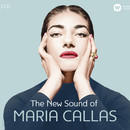
The New Sound Of Maria Callas
Maria CallasCD1
- Bellini: Norma - Casta Diva (Act I)
- Puccini: La bohème - Sì, mi chiamano Mimì (Act I)
- Puccini: La bohème - Donde lieta uscì (Act III)
- Puccini: Suor Angelica - Senza mamma
- Puccini: Gianni Schicchi - O mio babbino caro
- Verdi: La traviata - È strano! È strano! (Act I)
- Verdi: La traviata - Ah, fors’è lui (Act I)
- Verdi: La traviata - Sempre libera (Act I)
- Verdi: La traviata - Addio del passato (Act III)
- Verdi: Il trovatore - D’amor sull’ali rosee (Act IV)
- Bizet: Carmen - Habanera: L’amour est un oiseau rebelle (Act I)
- Choeurs René Duclos & Orchestre
- Massanet: Werther - Briefarie/Letter aria: Werther! Qui m’aurait dit … Des cris joyeux (Act III)
- Donizetti: Lucia di Lammermoor - Regnava nel silenzio alta la notte e bruna (Act I)
- Donizetti: Lucia di Lammermoor - Quando rapito in estasi (Act I)
- Rossini: La Cenerentola - Nacqui all’affanno e al pianto... Non più mesta (Act II)
- Rossini: Il barbiere di Siviglia - Una voce poco fa (Act I)
CD2
- Puccini: Tosca - Vissi d’arte (Act II)
- Puccini: Tosca - Com’è lunga l’attesa! (Act III)
- Puccini: La bohème - O soave fanciulla (Act I)
- Puccini: Turandot - Signore, ascolta (Act I)
- Puccini: Turandot - In questa reggia (Act II)
- Puccini: Turandot - Tu, che di gel sei cinta (Act III)
- Puccini: Madama Butterfly - Un bel dì vedremo (Act II)
- Bellini: La sonnambula - Compagne, teneri amici … Come per me sereno (Act I)
- Meyerbeer: Dinorah - Le Pardon de Ploërmel: Ombra leggiera (Act II)
- Verdi: I vespri siciliani - Boléro: Mercé, dilette amiche (Act V)
- Verdi: Aida - Ritorna vincitor! (Act I)
- Delibes: Lakmé - Glöckchenarie/Bell song: Dov’è l’indiana bruna (Act II)
- Charpentier: Louise - Depuis le jour où je me suis donnée (Act III)
- Gounod: Faust - Szene & Juwelenarie/scene and Jewel song: Il était un roi de Thulé … O Dieu ! que de bijoux … Ah ! je ris (Act III)
CD3
- Catalani: La Wally - Ebben? Ne andrò lontana (Act I)
- Verdi: Rigoletto - Gualtier Maldè… Caro nome (Act I)
- Verdi: La forza del destino - Sono giunta! Grazie, o Dio! (Act II)
- Verdi: La forza del destino - Madre, pietosa Vergine (Act II)
- Verdi: Macbeth - La luce langue (Act II)
- Cilea: Adriana Lecouvreur - Ecco: respiro appena... Io son l’umile ancella (Act I)
- Cilea: Adriana Lecouvreur - Poveri fiori (Act IV)
- Cilea: Adriana Lecouvreur - La mamma morta (Act III)
- Gluck: Alceste - Divinités du Styx (Act I)
- Gluck: Orphée et Eurydice - J’ai perdu mon Eurydice (Act IV)
- Bizet: Carmen - Seguedilla: Près des remparts de Séville (Act I)
- Bizet: Carmen - Zigeunerlied/Gypsy song: Les tringles des sistres tintaient (Act II)
- Massanet: Manon - Je ne suis que faiblesse … Adieu, notre petite table (Act II)
- Saint-Saens: Samson et Dalila - Printemps qui commence (Act I)
- Saint-Saens: Samson et Dalila - Mon coeur s’ouvre à ta voix (Act II)
- Gounod: Roméo et Juliette - Ah! Je veux vivre dans ce rêve (Act I)
Maria Callas – renaissance of a voice: unforgettable arias sung by the most iconic diva of all time – remastered for the first time in high-definition sound from the original tapes, for an unprecedented sound quality that shines new light on the voice of Maria Callas. Allan Ramsay, remastering engineer at Abbey Road Studios: “With high definition, you’ll be able to experience sounds which have only been heard so far by people who were either present at Callas’s recording sessions, or who had access to the unique master tape … All we wanted to do is remove the specks of dust, as it were, and wipe the glass clean.”
The New Sound of Maria Callas
Opera singers come and go, but just a few – the legends – live on. And Maria Callas was the greatest legend of them all, though not just for the wonder of her voice. She changed the way people thought about opera, but she also became famous as the glamorous celebrity who fell in love with Aristotle Onassis, leaving her elderly husband to live with him on his yacht Christina and enjoy the high life with the international jet set.
Of course it ended badly. She lived her life like one of her own tragic heroines who (as women tend to do in opera) sing, suffer and die. And her own death came at just 53, after a dazzling but short career that took in heavy roles alongside decorative, nightingale-like ones – ignoring the established rules of vocal health and probably explaining why her voice finally gave out as it did.
But in that time she did extraordinary things, using the muscle of those heavy heroines to empower the nightingales with strength and depth of feeling nobody had thought to offer them before. She gave them credibility as drama. Her performances were absolute and self-exposing: she held nothing back. And she was even tougher on herself than she could be on others – which is why her voice was never quite the flawless instrument singers are meant to cultivate. Her personality was far too volatile and too self-sacrificing in its love affair with risk.
In the mythology of opera, though, that’s what the audience demands. We want the diva to be both a goddess and a slave: to give her life for art. We thrill to the dimension of that sacrifice. And Callas dutifully obliged.
(Michael White, 2014)
CALLAS REMASTERED The new technology
When Maria Callas died in 1977, she was already a legend. Several attempts have been made over the years to re-master her studio and live recordings; it’s only now, four decades after La Divina’s death, that re-mastering technology has advanced to the point that a team of elite sound engineers could present these recordings with greater clarity than ever before, as if the listener was with Callas in the studio. The 2014 Maria Callas Remastered project presents her complete catalogue of studio albums and rarities from 1949-69 in a sound quality that has never previously been heard: for the first time each recording has been painstakingly re-mastered in 24-bit/96kHz sound at Abbey Road Studios using the original master tapes. Allan Ramsay, one of the team of engineers responsible for this remastering of all Callas’s studio recordings tells us:
“With high definition, you’ll be able to experience sounds which have only been heard up till now by people who were either present at Callas’s recording sessions, or who had access to the unique master tape. And digital editing software has become so sophisticated that we can correct problems which were insoluble even a few years ago. The listener will experience something as close as possible to the actual recording sessions. …
The best way to explain a high-definition remastering is to use the metaphor of a digital camera. Imagine the difference in image clarity between a 1-megapixel camera and a 12-megapixel camera. It gives an idea of the resolution we’re now able to achieve.. … We’re simply removing the inefficiencies of the recording process of the time. All we want to do is remove the specks of dust, as it were, and wipe the glass clean. We’re presenting the recording in the best possible light, and as the artists would have wanted it to be heard.’
(from an article by Warwick Thompson, 2014)