
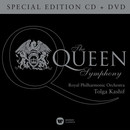
The Queen Symphony
Tolga Kashif, Royal Philharmonic OrchestraCD
- Radio Gaga – The Show Must Go On – One Vision – I Was Born to Love You
- Love of My Life – Another One Bites the Dust – Killer Queen
- Who Wants to Live Forever – Save Me
- Bicycle Race – Save Me
- Bohemian Rhapsody – We Will Rock You – We Are the Champions – Who Wants to Live Forever
- We Are the Champions – Bohemian Rhapsody – Who Wants to Live Forever
DVD
- Radio Gaga – The Show Must Go On – One Vision – I Was Born to Love You
- Love of My Life – Another One Bites the Dust – Killer Queen
- Who Wants to Live Forever – Save Me
- Bicycle Race – Save Me
- Bohemian Rhapsody – We Will Rock You – We Are the Champions – Who Wants to Live Forever
- We Are the Champions – Bohemian Rhapsody – Who Wants to Live Forever
Brian May, 2002:
“Imagine a composer of the imagination and daring of a Tchaikovsky, a Holst or a Mussorgsky. Imagine him let loose with the entire Queen catalogue of melodies, atmospheres and textures, and a vast orchestra and a huge choir. Then you'll be close to imagining where this work begins. This is something monumental and quite outrageous. The most exciting element is probably that the composer is absolutely NOT under our control – he feels no need to use whole songs, or even whole melodies unless he feels like it at any one moment. He uses fragments, pieces of underscoring and wild extrapolations to paint his own pictures. Tolga Kashif is a man with his own agenda in this Symphony, based on the body of work which Queen built up over 30 years or so, but taking the material to an entirely new place. This is the work of someone with a unique view and a new dream. I’m sure this composition, as usual with Queen-related works, will provoke some violent reactions. It breaks most of the ‘rules’ of symphonic form. But I am equally sure it will become an immortal favourite in the repertoire of orchestras, both amateur and professional, because it will deeply move an audience every time. And no-one will be able to dispute Mr Kashif’s skill in conjuring up every possible colour from a full symphony orchestra. The Romantic Tradition is alive and well in Tolga Kashif (in my opinion!)!!!”
The Queen Symphony is an integrated work for orchestra and choir in which I have hoped to express the original essence of this great music. In seeking to reinvent rather than purely orchestrate it, I have found that Queen’s music inherently contains the language of the modern classical genre.
This project has been more of a continuation of an onward journey since my early teens, when I was first exposed to the music of Queen. I remember hearing Bohemian Rhapsody for the very first time – waiting to go onto the cricket field to bat for my school team when a wall of voices sang “Is this the real life?” from a small radio over the pavilion green. Little did I know that some 25 years later I would be sitting at the piano with a commission from EMI Classics to compose a symphony inspired by such timeless music – music that has been part of the collective consciousness for some 30 years. Along with their contemporaries David Bowie and Genesis (to name but two), Queen were part of a radical new wave challenging the boundaries of popular music. They were the embodiment of a raw artistic expression that presented itself through meticulously crafted recordings and performances, which remain for us an indispensable legacy and a gift for future generations. In many respects, Queen’s music is embedded in the juxtaposition of classic and rock genres; the sound may be rock-orientated but, when stripped down to the bare components, the core contains as valid a thematic basis for symphonic treatment as any work in this genre. It is hard to put into words the compositional factor in this work, but improvisation and visualisation were at the heart of the process. Initial research soon revealed not only that I knew far more Queen lyrics and melodies than I had realised, but also that there were unexplored depths of meaning and lyricism within them. As I began sketching, the original themes began to coalesce into longer-form passages, while also taking on different contexts and characterisations.
The original Queen recordings naturally suggested an orchestral / choral canvas. Layered guitars resembled layers of orchestral strings; the diversity of solo expression in both voice and guitar – from extreme lyrical tenderness to rhapsodic exuberance – suggested the language of concerto or opera. The harmonic and melodic structures were reminiscent of Classical form, with intelligently woven counterpoint, while the chord progressions ranged from Medieval to Romantic influences. As well as the main themes, a subtext of secondary ones presented itself: the innocent piano figure from Bohemian Rhapsody, the riff from Another One Bites The Dust, the unmistakable turns of phrase in Brian’s guitar playing...
First Movement: The Radio Gaga motif and Show Must Go On refrains formed the motivic base for the movement and wrapped themselves in a stark landscape of layered strings – inspired by Brian’s distinctive layered guitar writing. I had images of the eternal struggle against the odds, powered by the lyric “One world, one vision”. By contrast, I Was Born To Love You appears as “fuel” for salvation. Second Movement: The lyrical Love Of My Life gave rise to a Classical / Pastoral piano concerto treatment, which is invaded by Another One Bites The Dust and Killer Queen as a tongue-incheek portrayal of a menacing duo conjuring up a storm! Third Movement: The yearning Who Wants To Live Forever is an elegiac dialogue between the violin and cello, against a mournful orchestral landscape. This is concluded by a short epilogue which points to resolution at the conclusion of the Symphony. Fourth Movement: Bicycle Race inspired this frenzied movement, in which I visualised the video of the song. The twist here, though, is that the participants escape into the city centre where chaos ensues. Fifth Movement: This opens with a parade of great Queen moments: Mama, Just Killed A Man…, We Will Rock You, Scaramouche – all characterised in a stylistic costume that culminates in the triumphant We Are The Champions and a reprise of Who Wants To Live Forever. Sixth Movement: This bears an unofficial title, “Homage”, which is based on a further recapitulation of Who Wants To Live Forever. This, I hope, is self-explanatory!
The first performance of The Queen Symphony was the culmination of a long creative process. Although the orchestra had, of course, played the work many times, both in rehearsal and for the CD recording, the experience of creating it anew for an audience was truly inspiring. Performing live, the musician travels from moment to moment, knowing that the experience is never to be repeated; thankfully, the essence of that feeling is documented on this DVD recording. I will always remember the union of creators, performers and listeners engendered by the sharing of this music on such a very special occasion. The presence of Brian May and Roger Taylor and their generous endorsement of the work moved me greatly and made the evening all the more memorable for the many Queen fans who attended. I was also deeply honoured that Jer Bulsara, Freddie Mercury’s mother, was able to be present.