
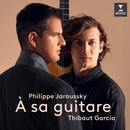
À sa guitare
Philippe Jaroussky, Thibaut GarciaLPA
- Francis Poulenc À sa guitare
- John Dowland Come again, sweet love doth now invite
- Giuseppe Giordani: Caro mio ben
- Francesca Caccini Chi desia di saper
- Enrique Granados El Mirar de la Maja (from 12 Tonadillas en estilo antiguo)
- Franz Schubert Erlkönig, D. 328
- Francis Poulenc Sarabande pour guitare, FP 179
- Barbara Septembre
- Henry Purcell If music be the food of love, Z.379
- John Dowland In Darkness Let Me Dwell (from A Musical Banquet)
- Luiz Bonfa Manha de Carnaval, from the original soundtrack of « Orfeu Negro »
LPB
- Dilermando Reis Xodo da Baiana
- Wolfgang Amadeus Mozart Abendempfindung, K.523
- Giovanni Paisiello Nel cor più non mi sento (from L'amor contrastato, ossia La molinara)
- Ariel Ramirez Alfonsina y el mar
- Gabriel Fauré: Au bord de l’eau, op.8 No.1
- Gabriel Fauré: Nocturne, op.43 No.2
- Gioachino Rossini Di tanti palpiti (from Tancredi, Act 1)
- Gerardo Matos Rodríguez La Cumparsita
- Henry Purcell When I Am Laid in Earth (Dido’s lament, from Dido and Aeneas, Z.626)
- Federico Garcia Lorca Anda, jaleo
- Benjamin Britten Il est quelqu’un sur terre (from «Folksongs arrangements »)
The first joint album from countertenor Philippe Jaroussky and guitarist Thibaut Garcia, À sa guitare takes its name from a song by the 20th century French composer Francis Poulenc. But the album’s frame of reference is extraordinarily wide, both culturally and stylistically. Its 22 tracks range across 400 years and music by composers and songwriters from France, Britain, Austria, Italy, Spain, Brazil, Argentina and the USA.
On the strictly classical side, among the best-known items are Dido’s lament ‘When I am laid in earth’, Schubert’s hair-raising ‘Erlkönig’, and the brilliant Rossini aria ‘Di tanti palpiti’. From nearer our own time there are such numbers as ‘Alfonsina y el mar’ by the Argentinian Ariel Ramírez (celebrated for his folk mass Misa Criolla), the wistful ‘Septembre’ by the legendary Parisian chansonnière Barbara.
Philippe Jaroussky and Thibaut Garcia first met in 2019 at the Victoires de la Musique, France’s equivalent of the Grammys. 2019 was also the year that brought the release of Jaroussky Passion, a triple album celebrating the 20th anniversary of the countertenor’s professional debut. While most of the material was drawn from Jaroussky’s substantial Erato catalogue, the collection also offered some brand new tracks. Garcia made a guest appearance on two of them – John Dowland’s ‘Flow my tears’(from the early 17th century) and Joseph Kosma’s ‘Les Feuilles mortes’ (from 1946). His debut album, Leyendas, had been released by Erato in 2016. Most recently (Autumn 2020) he released an album of works for guitar and orchestra, Aranjuez.
Jaroussky explains that, “Having made albums with orchestra or piano, my idea with À sa guitare was to work with some different colours, and to find colours in my voice that are different from the ones I use in, say, baroque music. There was also the idea of an album mixing a number of styles.” Thibaut Garcia takes up the thread: “The guitar has an image as both a classical instrument and a pop instrument, so it has a bit of a double life. On an album like this we can evoke hugely different colours as we juggle between renaissance music and a song by Barbara.”
“What struck me about Thibaut’s playing when I heard his first album was the finesse of his playing, his musicality as well as his virtuosity,” continues Jaroussky. “When we started rehearsing, I was impressed by his ease in following the vocal line – it comes very naturally to him. We cover a huge variety of languages, styles and periods on À sa guitare. When making our choices we needed to bear in mind that the countertenor voice isn’t suited to every French chanson or every pop song. I know that some things just aren’t right for me, so I’m always very careful about that.”
“For each number we had to find an arrangement that made the guitar sound at home,” says Garcia, who arranged a number of tracks on the album. “Some of the pieces were originally written with a piano in mind [for instance the three songs by Gabriel Fauré], but a guitar isn’t a piano, so you have to think of the music differently. Sometimes the guitar sounds like a lute, sometimes like a baroque guitar, sometimes like a much more modern guitar – sometimes even like a harp! … And that’s where the challenge of the guitar lies: it has lots of identities and we’re moving between them. You need to work at it … putting a touch of samba into the Brazilian music [two numbers by the 20th century composer César Guerra-Peixe], and a bit of one colour here and another colour there.”
Jaroussky describes “a journey between different cultures, different continents and different languages … There were some discoveries for me here, repertoire I wouldn’t have taken a look at under other circumstances. This was my first time recording in Brazilian Portuguese – and in Argentinian Spanish for Ramírez’s ‘Alfonsina’. Once again, you have to find the right colours. Various people helped me with that. Of course, we’ve got some classical French songs in there, but the idea was to take some risks … sometimes moving to a completely different world between one track and the next. The pieces we worked on the hardest, the ones we rehearsed the most, were ‘Septembre’ and ‘Alfonsina’. With the classical pieces we know our way around – there are more specific indications in the score and the pieces come together more easily.”
Garcia agrees that those two songs “took us out of our comfort zone” and explains the challenges of adapting music for the guitar. “If the writing is too harmonically dense, it won’t work on the guitar. And it can be very complicated to make a piece idiomatic. If the composer wrote it for piano, that’s how he conceived it. If he’d composed it for guitar, he would have written it differently. Perhaps the rhythms would have been differently notated, perhaps the harmonies would have been spaced differently. It’s up to the arranger to get into the composer’s skin, to understand what he would have done if he’d been working with a guitar. A musician’s job is to give a colour to the sound. A guitar doesn’t have one sound, it has hundreds, even thousands of sounds, and it’s our job to play with a palette of colours to produce something unique.”
“As Thibaut said, there are lots of different colours,” continues Jaroussky. “A colour I like very much on the guitar comes from the light harmonic notes we used from time to time – they are quite magical. Something else interesting is that people think of a singer playing a guitar. And that’s one of the reasons we decided to call the album À sa guitare’, after the song by Poulenc … It’s his guitar, not mine.” Poulenc’s song sets verses by the great 16th century poet Pierre Ronsard: an ode to the poet’s guitar, which gives him his voice as a lover.
“Some people are going to like the more ‘crossover’ element in the album,” says Jaroussky, “while others are going to like the kind of music I sing more often, such as the Dowland and Purcell and the Italian pieces [Giordani, Paisiello and Bellini, as well as Rossini]. I think the same applies when it comes to fans of the guitar … Both of us wanted to include some pieces for solo guitar [music by Purcell, Schubert and Poulenc], to shape the album into several sections and to create interludes – and perhaps to link different areas of repertoire.
“Looking at it from outside, some people might think that this is an ‘easy’ programme. Seeing it from the inside, it’s quite the opposite. I found this to be a very demanding programme from a musical point of view. At first glance, it might appear a bit of a catch-all, but the challenge for us was to find a focus for each piece, because each piece is a world in itself. During the recording sessions we sometimes took some time to find a tempo or phrasing that worked for both of us.”
“We really took it seriously,” agrees Garcia. “Some of the pieces could be seen as ‘crossover’, but that doesn’t mean we took them lightly … we worked on them in depth and brought a lot of musical integrity to the interpretation – or we hope so, anyway. As musicians, we put a great deal of thought into the album, but we also put our hearts into it.”