
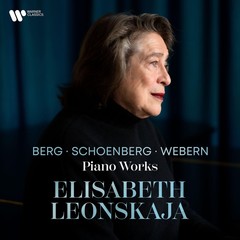
Berg, Schoenberg, Webern: Piano Works
Elisabeth Leonskaja- ALBAN BERG - Klaviersonate (Piano Sonata), Op.1
- ANTON WEBERN - Variationen für Klavier (Variations for Piano), Op. 27, I. Sehr mäßig (Very moderate)
- ANTON WEBERN - Variationen für Klavier (Variations for Piano), Op. 27, II. Sehr schnell (Very fast)
- ANTON WEBERN - Variationen für Klavier (Variations for Piano), Op. 27, III. Ruhig fließend (Calmly flowing)
- ARNOLD SCHONBERG - Drei Stücke (Three Piano Pieces), Op. 11, I. Mäßig (at a moderate speed)
- ARNOLD SCHONBERG - Drei Stücke (Three Piano Pieces), Op. 11, II. Mäßig (at moderate speed)
- ARNOLD SCHONBERG - Drei Stücke (Three Piano Pieces), Op. 11, III. Bewegt (with motion)
- ARNOLD SCHONBERG - Sechs kleine Klavierstücke (Six Little Piano Pieces), Op.19, I. Leicht, zart (Light, delicate)
- ARNOLD SCHONBERG - Sechs kleine Klavierstücke (Six Little Piano Pieces), Op.19, II. Langsam (Slow)
- ARNOLD SCHONBERG - Sechs kleine Klavierstücke (Six Little Piano Pieces), Op.19, III. Sehr langsam (Very slow )
- ARNOLD SCHONBERG - Sechs kleine Klavierstücke (Six Little Piano Pieces), Op.19, IV. Rasch, aber leicht (Brisk, but light)
- ARNOLD SCHONBERG - Sechs kleine Klavierstücke (Six Little Piano Pieces), Op.19, V. Etwas rasch (Somewhat brisk)
- ARNOLD SCHONBERG - Sechs kleine Klavierstücke (Six Little Piano Pieces), Op.19, VI. Sehr langsam (Very slow)
- ARNOLD SCHONBERG - Suite Op. 25, I. Präludium (Prélude)
- ARNOLD SCHONBERG - Suite Op. 25, II. Gavotte
- ARNOLD SCHONBERG - Suite Op. 25, III. Musette
- ARNOLD SCHONBERG - Suite Op. 25, IV. Gavotte da capo
- ARNOLD SCHONBERG - Suite Op. 25, V. Intermezzo
- ARNOLD SCHONBERG - Suite Op. 25, VI. Menuett
- ARNOLD SCHONBERG - Suite Op. 25, VII. Trio
- ARNOLD SCHONBERG - Suite Op. 25, VIII. Menuett da capo
- ARNOLD SCHONBERG - Suite Op. 25, IX. Gigue
Elisabeth Leonskaja, long resident in Vienna, enjoys special renown as an interpreter of the Classical and Romantic Austro-German repertoire. Composers such as Mozart, Beethoven, Schubert and Brahms figure prominently in her Warner Classic catalogue. Her recording of Mozart’s Complete Piano Sonatas, released in 2022, prompted BBC Music Magazine to draw a crucial conclusion: “Perfection? For me, it’s a yes.”
Now Leonskaja turns to the three composers of the so-called Second Viennese School – Arnold Schoenberg and his pupils Alban Berg and Anton Webern. The release of this album of solo piano music coincides with the 150th anniversary of Schoenberg's birth in Vienna, on 13 th September 1874.
The longest uninterrupted span of music on the programme is Berg’s single-movement Piano Sonata, his opus No 1. Composed in the first decade of the 20th century, it stands on the cusp between Romanticism and Modernism, anchored in traditional forms and acknowledging tonality, yet also exploring new structural and harmonic possibilities. Webern’s op 27 Variations, which date from three decades later, are meticulously crafted miniatures, written using the 12-tone system pioneered by Schoenberg.
The album contains three sets of pieces by Schoenberg himself: the Three Piano Pieces, op 11, composed in 1909 and revised in 1924 (1909 was also the year that he wrote Erwartung – a monodrama for soprano and orchestra – and his seminal Five Pieces for Orchestra); the Six Little Pieces op 10, a set of aphoristic, atonal, sometimes witty statements, none lasting more than a minute-and-a-half, and the Suite op 25, dating from the early 1920s, when Schoenberg crystallised his transformative 12-tone principles, but acknowledging the past with dance forms: a gavotte, a musette, a minuet and a gigue.
When Elisabeth Leonskaja played the suite at London’s Wigmore Hall in 2022, Seen and Heard International’s writer judged that: “Her understanding of Schoenberg’s piano writing and vocabulary in this performance was magnificent. The repeated notes of the opening Präludium held infinite energy. The piece was flighty at times, dancing at others … When it came to the Intermezzo … Leonskaja brought a sense of drama but also, in pianistic terms, the most perfect legato and sense of line. [The] Menuett and Trio must be one of the most elusive ever penned, and Leonskaja held its sense of mystery throughout before the Gigue brought a splendidly light touch …. Some of the finest Schoenberg playing I have heard.”