
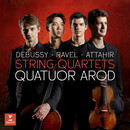
Debussy, Ravel, Attahir: String Quartets
Quatuor ArodCD
- String Quartet in G Minor, Op. 10, CD 91, L. 85; I. Animé et très décidé (Claude Debussy)
- String Quartet in G Minor, Op. 10, CD 91, L. 85; II. Assez vif et bien rythmé (Claude Debussy)
- String Quartet in G Minor, Op. 10, CD 91, L. 85; III. Andantino doucement expressif (Claude Debussy)
- String Quartet in G Minor, Op. 10, CD 91, L. 85; IV. Très mouvementé et avec passion (Claude Debussy)
- Al' Asr, I. Intense (Benjamin Attahir)
- Al' Asr, II. Ancora poco più mosso (Benjamin Attahir)
- Al' Asr, III. Lontano e misterioso (Benjamin Attahir)
- Al' Asr, IV. Agitato (Benjamin Attahir)
- Al' Asr, V. Fuga (Benjamin Attahir)
- String Quartet in F Major, M. 35, I. Modéré - Très doux (Maurice Ravel)
- String Quartet in F Major, M. 35, II. Assez vif. Très rythmé (Maurice Ravel)
- String Quartet in F Major, M. 35, III. Très lent (Maurice Ravel)
- String Quartet in F Major, M. 35, IV. Vif et agité (Maurice Ravel)
DVD
- Ménage à Quatre (Documentary)
The string quartets of Debussy and Ravel, composed within a decade of each other, make a natural pairing. The Arod Quartet, celebrating its 10th anniversary in 2023, sets these two belle époque masterpieces in a present-day context with a third work: Al Asr, by the young French composer Benjamin Attahir. The scope of this Erato release is further expanded with a DVD documentary directed by Bruno Monsaingeon – celebrated for his profiles of musicians ranging from Yehudi Menuhin, Glenn Gould and Nadia Boulanger to the Alban Berg Quartet, Piotr Anderszewski and David Fray. It is called Ménage à quatre, and, as Monsaingeon says, “explores the secret of the harmonious life of a string quartet”. In addition to the entire third movement of Debussy’s string quartet, the documentary features music by Bach, Haydn, Mozart, Beethoven, Bartók, Ravel and György Kurtág Now in his late nineties, Kurtág also makes an appearance in the film.
When Bruno Monsaingeon heard the Arod Quartet for the first time, he wondered: “Had I ever heard such sheer strength of attack, such dramatic power, such a variety of sonic colour or dramatic range – all combined with such prodigious delicacy of phrasing, and a unique capacity for moving seamlessly from fortissimo to pianissimo?” Intensity is a characteristic of the Arod Quartet’s interpretations. Their debut on Erato brought a version of Mendelssohn’s Quartet No 2 that was hailed by BBC Music Magazine as “one of the most intense, detailed and passionate accounts … ever recorded,” notable for “hair-trigger clarity of articulation and volatility of expression”. Gramophone, noting that “the Arod always compel with their questing imagination,” judged the ensemble’s reading of Schubert’s ‘Death and the Maiden’ quartet to be “imaginatively coloured, uncommonly wide in dynamic range …[combining] clarity of detail with a thrilling, desperate abandon”. The Mathilde Album, which programmed works by Viennese coevals of Debussy and Ravel – Schoenberg, Zemlinsky and Webern – caused Gramophone to speak of “single-minded clarity of purpose”, to describe the Arod Quartet’s reading of Zemlinsky’s Second Quartet as “simply irresistible”, and to conclude: “It’s an outstanding album.”
Like the Debussy and Ravel quartets, Benjamin Attahir’s Al Asr runs for around 25 minutes. The Arod Quartet premiered the piece in Paris in 2017. Attahir, born in Toulouse in 1989, originally trained as a violinist and became friendly with the players of the Arod Quartet as fellow students at the Paris Conservatoire. He counts Pierre Boulez among his mentors and has collaborated with such artists as Daniel Barenboim, Renaud Capuçon, Bertrand Chamayou and Emmanuel Pahud. Groups that have performed his works include the Orchestre National de France, Orchestre Philharmonique de Radio France, Orchestre du Capitole de Toulouse, Ensemble Intercontemporain, Staatskapelle Berlin, Helsinki Philharmonic Orchestra, Chamber Orchestra of Lausanne, and West-Eastern Divan Ensemble.
Of Moroccan and Lebanese descent, Attahir draws on multiple cultural influences in creating his works. The name Al-Asr refers to a chapter of the Koran, pondering the question of time, which is referenced in the Muslim afternoon prayer. Attahir has written that: “My aim was to transcribe in musical form the atmosphere of this precise moment of the day [midway between noon and sunset]. Harsh light, sweltering heat, the iridescence of the air as it makes contact with the surface of the ground – these are the images that accompanied me as I wrote this quartet. The structure of the chapter in three verses dictated the general form of the work, without highlighting the sacred text itself. It was always the poetic and allegorical aspect that guided my work. The four strings are treated like a single instrument, reconnecting with the backbone of my writing: ornate monody, freely inspired by the music of the Middle East. Broadly taking as its basis the image of a scooter buffeted about by Roman cobblestones, the piece conveys this dazzling roughness, these jolts muffled by the smells of pine trees and hot soil, all flowing in the bath of an uneasy weariness ... Al Asr is dedicated to my wonderful friends in the Quatuor Arod, who have brought it to life in a way I would never have dared to dream.”