
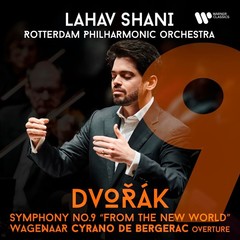
Dvořák: Symphony No. 9 "From the New World” / Wagenaar: Cyrano de Bergerac
Lahav Shani, Rotterdam Philharmonic Orchestra- JOHAN WAGENAAR - Cyrano de Bergerac Op. 23, Ouverture
- ANTONÍN DVOŘÁK - Symphony No. 9 in E Minor Op. 95, “From the New World”, I. Adagio - Allegro Molto
- ANTONÍN DVOŘÁK - Symphony No. 9 in E Minor Op. 95, “From the New World”, II. Largo
- ANTONÍN DVOŘÁK - Symphony No. 9 in E Minor Op. 95, “From the New World”, III. Molto vivace
- ANTONÍN DVOŘÁK - Symphony No. 9 in E Minor Op. 95, “From the New World”, IV. Allegro con fuoco
Dvořák’s much-loved Symphony No. 9 ‘From the New World’ now joins the sequence of symphonies, ranging from the dawn of musical Romanticism to the 1930s, recorded for Warner Classics by the Rotterdam Philharmonic Orchestra and its Chief Conductor Lahav Shani. It takes its place alongside works by Beethoven, Mendelssohn, Bruckner, Weill and Shostakovich. In 2023, reviewing the recording of Bruckner’s Symphony No. 7, Gramophone wrote “This is as fine a recorded account … as I’ve heard for some time, both in terms of Lahav Shani’s conception of the music and its realisation on the orchestra.” Dvořák’s ‘New World’ received its premiere (in New York in 1893) less than 10 years after Bruckner’s monumental symphony reached its final form, but the two works do indeed inhabit different worlds. In the early 1890s Dvořák, born in Bohemia in 1841, held the post of Director at the National Conservatory in New York. The ‘New World’ fuses his characteristic Romantic idiom, imbued with Slavonic spirit, with elements of African-American music (notably the spiritual ‘Swing Low, Sweet Chariot) and inspiration drawn from Henry Wadsworth Longfellow’s poem Hiawatha, an epic tribute to Native American culture. The achingly beautiful cor anglais melody in the symphony’s second movement (famously adapted in 1922 for the song ‘Goin’ Home’ by Williams Arms Fisher, who had studied with Dvořák in New York) inevitably seems expressive of the composer’s nostalgia for his home in Central Europe.
Paired with Dvořák’s Symphony No. 9 is a far more rarely heard work, dating from 1905, by the Dutch composer Johan Wagenaar (1862-1941). His concert overture, Cyrano de Bergerac portrays the eloquent hero of Edmond de Rostand’s celebrated tragi-comic play, first staged, in Paris, in 1897. Wagenaar’s overture, with its impetuous opening, soaring melodies and brilliant orchestration, is unmistakably in the vein of Richard Strauss’s sumptuous symphonic poem Don Juan. When Shani and the Rotterdam Philharmonic gave a concert performance of the work in late 2025, the critic of De Nieuwe Muze hailed “an exciting adventure story in sound”, writing that the musicians “swept away every trace of dust with theatrical grandeur, making clear that the work remains very much worthy of attention.”