
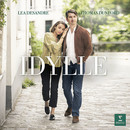
Idylle
Lea Desandre & Thomas Dunford- D’AMBRUYS - Le doux silence de nos bois
- HAHN - Études latines - No. 2, Néère
- HARDY - Le temps de l'amour
- SATIE - Gnossienne No.1
- CHARPENTIER - Celle qui fait tout mon tourment, H. 450
- CHARPENTIER - Auprès du feu l'on fait l'amour, H. 446
- CHARPENTIER - Tristes déserts, sombre retraite, H. 469
- MESSAGER - L'Amour masqué, Act 1 - 'J'ai deux amants' (Elle)
- SATIE - Gymnopédie - No. 1, Lent et douloureux
- LAMBERT - Ma bergère est tendre et fidèle
- HAHN - À Chloris
- CHARPENTIER - Sans frayeur dans ce bois, H. 467
- DE VISÉE - Suite No. 7 en ré mineur - III. Sarabande
- HARDY - Le premier bonheur du jour
- LE CAMUS - On n'entend rien dans ce bocage
- DEBUSSY - Pelléas et Mélisande, CD 93, L. 88, Act 3 - 'Mes longs cheveux descendent' (Mélisande)
- LAMBERT - Ombre de mon amant
- LAMBERT - Vos mépris chaque jour
- DE VISÉE - Suite No. 7 en ré mineur - V. Chaconne
- BARBARA - Dis, quand reviendras-tu
- LE CAMUS - Laissez durer la nuit
- OFFENBACH - La Belle Hélène, Act 1 - 'Amours divins' (Hélène)
French love songs from three centuries, interspersed with reflective lute solos, constitute an Idylle for mezzo-soprano Lea Desandre and lutenist Thomas Dunford. As they explain: “The emotions of love are explored in different forms – languor, desire, fascination, happiness.” The original inspiration for the album lies in the beautiful and verdant coastal region of the Vendée in western France, where the two musicians first met.
The modern meaning of the word ‘idyll’, a blissful, tranquil experience, derives from its Ancient Greek origins as a poem on a pastoral theme. With Idylle, Desandre and Dunford spin a thematic and musical thread between eras and styles.
The album opens with a sequence of 10 airs de cour from the 17th century, written by Marc-Antoine Charpentier, Michel Lambert, Sébastien Le Camus and Honoré d’Ambruys. Spanning the era from the 1860s to the 1920s are Offenbach’s gently seductive ‘Amours divins!’ (from the operetta La Belle Hélène), Debussy’s haunting ‘Mes longs cheveux descendent’ (from the opera Pelléas et Mélisande), Hahn’s entrancingly poised song ‘A Chloris’, and ‘J’ai deux amants’, a cheeky number from André Messager’s musical comedy L’amour masqué. The album then fast-forwards to the 1960s and two women who achieved iconic status in that revolutionary decade: singer-songwriter Barbara, one of the great exponents of ‘la chanson française’, and Françoise Hardy, originally a luminary of ‘la musique yé-yé’. The instrumental interludes, played on the theorbo, take the form of two dances by Robert de Visée, a musician at the courts of both Louis XIV and Louis XV, and two characteristically enigmatic pieces by Erik Satie, his Gymnopédie No 1 and Gnossienne No 1.
Lea Desandre has been praised (by London’s Independent) for singing “like a dove from heaven … with such grace that she spreads an ecstatic stillness through the hall”, and Eternal Heaven, the Erato album of Handel arias that she recorded with Thomas Dunford and countertenor Iestyn Davies, was singled out for its “beauty, expressive eloquence and musical imagination” by Opera News. Forum Opéra wrote that: “Once again, Lea Desandre puts her superb timbre, her huge talent and her virtuosity at the service of the text she is singing,” while Gramophone lauded “an album that reaches deep into Handel’s genius”.