
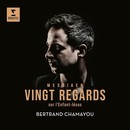
Messiaen Vingt Regards Sur L'enfant-Jesus
Bertrand ChamayouCD1
- Live Ear Emission! "Homage to Olivier Messiaen"
- Rain Tree Sketch II "In Memoriam Olivier Messiaen"
- Cloches D'adieu, Et Un Sourire... "In Memoriam Olivier Messiaen"
- Vingt Regards Sur L'enfant-Jésus: No. 1, Regard Du Père
- Vingt Regards Sur L'enfant-Jésus: No. 2, Regard de L'étoile
- Vingt Regards Sur L'enfant-Jésus: No. 3, L'échange
- Vingt Regards Sur L'enfant-Jésus: No. 4, Regard de la Vierge
- Vingt Regards Sur L'enfant-Jésus: No. 5, Regard Du Fils Sur Le Fils
- Vingt Regards Sur L'enfant-Jésus: No. 6, Par Lui Tout a ÉTÉ Fait
- Vingt Regards Sur L'enfant-Jésus: No. 7, Regard de la Croix
- Vingt Regards Sur L'enfant-Jésus: No. 8, Regard Des Hauteurs
- Vingt Regards Sur L'enfant-Jésus: No. 9, Regard Du Temps
- Vingt Regards Sur L'enfant-Jésus: No. 10, Regard de L'esprit de Joie
CD2
- Vingt Regards Sur L'enfant-Jésus: No. 11, Première Communion de la Vierge
- Vingt Regards Sur L'enfant-Jésus: No. 12, la Parole Toute Puissante
- Vingt Regards Sur L'enfant-Jésus: No. 13, Noël
- Vingt Regards Sur L'enfant-Jésus: No. 14, Regard Des Anges
- Vingt Regards Sur L'enfant-Jésus: No. 15, Le Baiser de L'enfant-Jésus
- Vingt Regards Sur L'enfant-Jésus: No. 16, Regard Des Prophètes, Des Bergers Et Des Mages
- Vingt Regards Sur L'enfant-Jésus: No. 17, Regard Du Silence
- Vingt Regards Sur L'enfant-Jésus: No. 18, Regard de L'onction Terrible
- Vingt Regards Sur L'enfant-Jesus: No. 19, Je Dors, Mais Mon Cour Veille
- Vingt Regards Sur L'enfant-Jésus: No. 20, Regard de L'église D'amour
- Humble Regard Sur Olivier Messiaen
- Tombeau de Messiaen for Piano and Digital Audio Tape
Composed in a flash of inspiration, Vingt Regards sur l'Enfant-Jésus is a veritable 20th-century landmark, a giant fresco, an odyssey. Messiaen draws on the full wealth of his musical language, from plainchant to Hindu and Greek rhythms to birdsong. At once universal and self-evident, the work seems imbued with a certain truth.
Booklet Notes written by Bertand Chamayou:
“The most beautiful experience we can have is the mysterious. It is the fundamental emotion that stands at the cradle of true art and true science … A knowledge of the existence of something we cannot penetrate, our perceptions of the profoundest reason and the most radiant beauty, which only in their most primitive forms are accessible to our minds: it is this knowledge and this emotion that constitute true religiosity. In this sense, and only this sense, I am a deeply religious man.”
From the mouth of Albert Einstein. I would struggle to express more aptly, more precisely the feeling I have when confronted with that which is, in the noblest sense, beyond me – beyond US.
Whether or not we believe in a God, mysticism, for those who know how to give themselves up to it, resides in the observation of nature, and can soon become overwhelming as we try to ponder the universe around us.
We might talk of contemplation, wonder, exaltation. But that, to me, suggests something ineffable; whereas mystery becomes undoubtedly a little more tangible in the face of human genius, be it in the brevity of a haiku or in some monumental creation – a cathedral, say, to cite the first example that springs to mind.
Vingt Regards sur l’Enfant-Jésus (Twenty visions of the infant Jesus) is one such monument of the 20th century.
Olivier Messiaen wrote this score in a flash of brilliance over the course of just a few months in 1944. It is a colossal saga, an odyssey. More so, I think, than in any other of his works, he envelops it in the immeasurable richness of his musical language, with its sacred roots, the influence of Gregorian chant, the acoustic cosmos of the organ and its stops, numerous chimes ring out here and there, core leitmotivs pervade the whole: the Theme of God; of the Star and the Cross; of Mystical Love… All around these solid foundations, the myriad inspirations that form the essence, the singularity of Messiaen’s style: bird songs, exotic melodies, his trademark ancient Greek and Hindu rhythms, his shimmering harmonies in synaesthetic chemistry with equally shimmering colours. Yet the overarching momentum remains in the realm of the divine.
“The misfortune of my life,” the composer once confessed, “is that I have written religious music for a faithless audience.”
When you hear the music, you can’t help being struck by its universal quality.
I was just a child, around nine years old, when I read and heard this piece for the first time. It proved a formative shock, a revelation that significantly swayed my course. Besides whiling away the hours attempting to emulate Messiaen’s style, I think it fair to say that Regards, this boundless conceptual realm written for piano, partially shaped my way of playing, my sound, my perception of artistry.
It’s been part of me for more than 30 years now.
What strikes me most today, I think, is the astonishing paradox embedded in the cycle, also visible in other pieces of his from the same period (Quatuor pour la fin du temps, Visions de l’Amen, Trois petites liturgies de la présence divine, or the Turangalîla-Symphony): a near perfect balance of complexity and evidence.
As with a living organism, everything here is highly elaborate. Every chord, every rhythm, the heaving flow of the composition, the continuous gushing abundance, all products of a complex, ostensibly sophisticated mind. But what really shines through is the triumph of evidence, a sense of beholding a certain truth.
The result is a climax of grace and power, the force of which seems to devastate everything in its path.
No easy task then to compile a complementary programme that can do it justice.
I chose what felt like the most moving solution: to frame this immense masterpiece with various homages to Messiaen himself, written for the most part after his passing by a highly diverse set of artists, but who all share a certain debt to him.
As a prelude, a short early piece by Anthony Cheung, Live Ear Emission!, full of freshness and vitality. Two rather more mournful pieces follow, Tōru Takemitsu’s painful Rain Tree Sketch II and Tristan Murail’s Cloches d’adieu, et un sourire… with its sublime, haunting crystalline sound.
As a sort of post-script, …humble regard sur Olivier Messiaen… by György Kurtág, as brief and restrained as the name suggests. And finally, to lead us out, Jonathan Harvey’s apocalyptic Tombeau de Messiaen.