
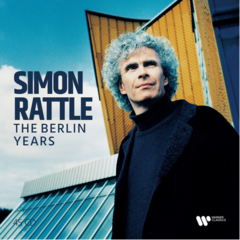
The Berlin Years (CD45)
Simon RattleCD1 LIZST - EINE FAUST-SYMPHONIE
CD2 MAHLER - SYMPHONY NO. 10
CD3 SCHOENBERG - GURRELIEDER
CD4 SCHOENBERG - GURRELIEDER
CD5 MAHLER - SYMPHONY NO. 5
CD6 BEETHOVEN - FIDELIO
CD7 BEETHOVEN - FIDELIO
CD8 MESSIAEN - ECLAIRS SUR L'AU-DELÀ...
CD9 ORFF - CARMINA BURANA
CD10 DVORAK - 4 SYMPHONIC POEMS
CD11 DVORAK - 4 SYMPHONIC POEMS
CD12 DEBUSSY - PRÉLUDE À L'APRÈS MIDI D'UN FAUNE, LA MER, LA BOITE À JOUJOUX...
CD13 BRITTEN - LES ILLUMINATIONS, SERENADE, NOCTURNE
CD14 R. STRAUSS - EIN HELDENLEBEN, LE BOURGEOIS, GENTILHOMME (SUITE)
CD15 SCHUBERT - SYMPHONY NO. 9 'THE GREAT'
CD16 SHOSTAKOVICH & PROKOFIEV - VIOLIN CONCERTO NO. 1
CD17 SHOSTAKOVICH - SYMPHONIES NOS. 14 & 1
CD18 SHOSTAKOVICH - SYMPHONIES NOS. 14 & 1
CD19 HOLST - THE PLANETS, ASTEROIDS, ADES - TEVOT
CD20 HOLST - THE PLANETS, ASTEROIDS, ADES - TEVOT
CD21 DAS PARFUM (THE STORY OF A MURDERER) (O.S.T.)
CD22 BRAHMS - EIN DEUTSCHES REQUIEM
CD23 BRUCKNER - SYMPHONY NO. 4
CD24 HAYDN - SYMPHONIES NOS. 88-92, SINFONIA CONCERTANTE IN B-FLAT
CD25 HAYDN - SYMPHONIES NOS. 88-92, SINFONIA CONCERTANTE IN B-FLAT
CD26 NIELSEN - FLUTE CONCERTO, CLARINET CONCERTO
CD27 MUSSORGSKY - PICTURES AT AN EXHIBITION, BORODIN - SYMPHONY NO. 2, POLOVTSIAN DANCES
CD28 MAHLER - SYMPHONY NO. 9, BARBER - ADAGIO
CD29 MAHLER - SYMPHONY NO. 9, BARBER - ADAGIO
CD30 STRAVINSKY - SYMPHONY IN THREE MOVEMENTS, SYMPHONY OF PSALMS, SYMPHONY IN C
CD31 BERLIOZ - SYMPHONIE FANTASTIQUE, LA MORT DE CLÉOPÂTRE
CD32 RAVEL - L'ENFANT ET LES SORTILÈGES, MA MÈRE L'OYE
CD33 BRAHMS - SYMPHONIES NOS. 1-4
CD34 BRAHMS - SYMPHONIES NOS. 1-4
CD35 BRAHMS - SYMPHONIES NOS. 1-4
CD36 TCHAIKOVSKY - THE NUTCRACKER
CD37 TCHAIKOVSKY - THE NUTCRACKER
CD38 MAHLER - SYMPHONIE NO. 2 'RESURRECTION'
CD39 MAHLER - SYMPHONIE NO. 2 'RESURRECTION'
CD40 SCHOENBERG - ORCHESTRAL WORKS
CD41 BRUCKNER - SYMPHONY NO. 9
CD42 BIZET - CARMEN
CD43 BIZET - CARMEN
CD44 STRAVINSKY - LE SACRE DU PRINTEMPS, SYMPHONIES OF WIND INSTRUMENTS, APOLLON MUSAGÈTE
CD45 RACHMANINOV - THE BELLS, SYMPHONIC DANCES
The chemistry between tradition and innovation powered Sir Simon Rattle’s relationship with the Berliner Philharmoniker, above all during his time as the orchestra’s Chief Conductor and Artistic Director (2002-2018). As the successor to Wilhelm Furtwängler, Herbert von Karajan and Claudio Abbado, his mission was to take this pre-eminent musical institution into the 21st century. “What Rattle has brought … is a new spirit of adventure,” declared The Times in 2006, and later looked back on the “exhilarating, epoch-hopping eclecticism of Simon Rattle’s era in Berlin”. Through all this Rattle preserved the orchestra’s distinctive sonority, notable, in the words of the New York Times, for its “sheer grandeur … and rich, red-blooded warmth”. He first conducted the Berliner Philharmoniker in 1987, and the recordings in this 45CD box span the years from 1994 to 2012. Very much reflecting Rattle’s vision for the orchestra, the symphonic, choral and operatic works range from pillars of Austro-German Classicism, Romanticism and Modernism through French, Russian and Czech repertoire to showcases for contemporary contemporary composers from around the world – and even a film soundtrack. As Rattle said at the end of his tenure in Berlin: “Music is for everybody, and we’ve all believed this.”
Sir Simon Rattle and the Berlin Philharmonic – context
Sir Simon Rattle: The Berlin Years (45CDs) brings together all the recordings that the British conductor Sir Simon Rattle (b.1955) made with the Berliner Philharmoniker in the years from 1994 to 2012 for EMI Classics (now Warner Classics).
Simon Rattle first conducted the Berliner Philharmoniker in 1987 (Mahler’s Symphony No. 6) and later said: “I had the feeling that I would find my voice that day.” (At the time he was Principal Conductor and Artistic Adviser of the City of Birmingham Symphony Orchestra – he was in charge of the CBSO from 1980 to 1998. The first of his many recordings for EMI had been released in 1978.)
In 2002, having conducted the Berliner Philharmoniker 58 times, Rattle became the orchestra’s Chief Conductor and Artistic Director. He remained in the post until 2018.
In 2017, Rattle took up the position of Music Director of the London Symphony Orchestra, ending his tenure in June 2023. In September 2023, he began his tenure as Chief Conductor of the Symphonieorchester des Bayerischen Rundfunks in Munich.
The Berliner Philharmoniker, founded in 1882, is undoubtedly among the world’s great orchestras. Indeed, it is often described as the world’s greatest orchestra.
Simon Rattle’s immediate predecessor as Chief Conductor was Claudio Abbado (tenure from 1990-2002), who succeeded Herbert von Karajan (tenure 1957-1989) and Wilhelm Furtwängler (1922-1934 / 1952-1954).
Sir Simon Rattle and the Berlin Philharmonic – a transformative era
The Berliner Philharmoniker is self-governing and Rattle was elected as Chief Conductor by the orchestra’s players in 1999. The other main contender was Daniel Barenboim. This is how one of the orchestra’s horn players recalled the choice faced by the orchestra: “Do we turn the clock back, be a more traditional orchestra with a living museum role, or do we embrace the future?”
Rattle was a somewhat unorthodox choice: in 1999 he was associated less with Austro-German symphonic music of the late 18th/19th centuries than with diverse and eclectic repertoire from later eras. Over his 16 years with the Berliner Philharmoniker, Rattle both asserted his authority in the orchestra’s traditional repertoire and broadened its musical horizons to run from early music to new commissions.
In 2018 The Guardian wrote of Rattle’s mission to “maintain Berlin's wonderful sound, forged in the eras of Wilhelm Furtwängler and Herbert von Karajan during the mid-20th century, but simultaneously throw open the doors to the Philharmonie and drag what is still widely regarded as the greatest symphony orchestra in the world into the 21st century.” The writer admired “the sheer quality and intensity of the orchestral playing … how [the] wind players are at the same time … expressively independent and yet form a … seamless, cohesive unit, and how the strings manage to combine a wealth of detail with fathomless depth of tone.” In 2015 the New Yok Times had written of “the sheer grandeur of the Berlin Philharmonic sound” and its “assertive confidence and rich, red-blooded warmth”.
Citing the “exhilarating, epoch-hopping eclecticism” of Rattle’s approach to repertoire in Berlin, the Times wrote that “What Rattle has brought … is a new spirit of adventure … the Berliners sound rejuvenated.”
Rattle’s achievement in the Romantic Austro-German repertoire was expressed in a 2018 Times review of a Berliner Philharmoniker performance of Bruckner’s Symphony No. 9 (CD41): “What will chiefly be remembered about his German years, however — and tremendously evident in this turbulent and profound account of Bruckner’s complex score — is his genius for digging beneath surfaces that say one thing and finding chasms of dark matter saying something very different. It’s possible to play this epic as the zenith of 19th-century symphonic aspiration, but in Rattle’s hands it sounded experimental and unresolved, as though Bruckner, even in his last moments, was determined to say prophetic and challenging things to those who came after him.”
At the end of his time as Chief Conductor, Rattle said: “I think we moved this big, big ship forward … Music is for everybody, and we’ve all believed this, and this was really one of my most important goals while I was here … To spread it everywhere.”
Sir Simon Rattle: The Berlin Years – overview
The 45 CDs in the box provide a representative picture of Rattle’s years with the Berlin Philharmonic. The repertoire ranges from the 18th century (Haydn – a composer long favoured by Rattle) to the 21st century (even the score for the 2006 film Das Parfum). It embraces symphonic music (including spectacular works from the late-Romantic/Modern eras), choral music and opera, all from a diversity of national and cultural traditions. The ‘traditional’ Austro-German repertoire is given its due.