
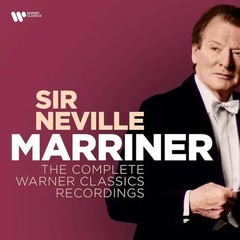
The Complete Warner Classics Recordings (CD80)
Sir Neville MarrinerTBA
“The man is simply a legend,” wrote The Guardian on the occasion of Sir Neville Marriner’s 90th birthday in 2014. After his death in 2016 it celebrated “a life of music-making of the highest quality that gave pleasure to many.” Over his long career, Marriner built a substantial and admired discography, becoming one of the most-recorded and best-selling conductors of all time. He is associated above all with the Academy of St Martin in the Fields, the chamber orchestra he founded with a group of colleagues in 1958. Prominent in this richly varied collection, the Academy consistently embodies a fresh and stylish spirit that proved transformational in Baroque and Classical repertoire and illuminated music from the 19th and 20th centuries. Marriner’s distinction and influence as a conductor is further demonstrated by recordings he made with the Radio-Sinfonieorchester Stuttgart, Staatskapelle Dresden, London Symphony Orchestra, Northern Sinfonia, Los Angeles Chamber Orchestra and Minnesota Orchestra.
Sir Neville Marriner – a centenary overview
Sir Neville Marriner: The Complete Warner Classics Recordings (80CDs) brings together all the recordings that the British conductor Sir Neville Marriner (1924-2016) made for EMI Classics (75 CD), Erato (3 CD), Virgin Classics (1 CD) and Teldec (1 CD) over the years between 1970 and 2000.
Marriner’s centenary falls on 15th April 2024.
On the occasion of Marriner’s 90th birthday in 2014, the Guardian wrote: “By some estimates, … Sir Neville has sold more classical recordings than any other musician ever. The man is simply a legend.”
After his death, the Guardian wrote: “[Marriner’s] was a life of music-making of the highest quality that gave pleasure to many.” The Telegraph wrote: “For energy and output, Marriner had few equals. He made more than 600 recordings of 2,000 musical works, a greater legacy than any conductor except Karajan.”
Marriner recorded first and foremost with The Academy of St Martin in the Fields, the chamber orchestra he founded in 1958, and which continues to enjoy a reputation as one of the world’s finest chamber orchestras.
This set also includes recordings made with the Radio-Sinfonieorchester Stuttgart, Staatskapelle Dresden, London Symphony Orchestra, Northern Sinfonia, Los Angeles Chamber Orchestra and Minnesota Orchestra
Marriner originally made a reputation as a conductor of 18th century music, pioneering an historically informed approach while using modern instruments. Bach, Handel, Haydn and Mozart hold a prominent position in this 80CD box, but the repertoire ranges wide, from the 17th century to the late 20th century, embracing symphonic music, concertos, choral works, orchestral songs, excerpts from opera and operetta, and works with a narrator.
In addition to his extensive Warner Classics catalogue, Sir Neville Marriner conducted a substantial number of recordings that are now in the Universal Classics catalogue.
His best-selling recording, made with the Academy of St Martin in the Fields, is the soundtrack to the 1984 film Amadeus. Originally released on the Metronome label, it has sold some 6.5 million copies.
Career trajectory and The Academy of St Martin in the Fields
Sir Neville Marriner was born on 1924 in the English city of Lincoln. His first teacher for violin and piano was his father, a carpenter by profession.
He 1939 he began violin studies at the Royal College of Music. He served in the army from 1941 to 1943, but returned to the Royal College and went on to spend a year at the Paris Conservatoire.
After a short time as a music teacher, he began to make his living as a chamber and orchestral musician notably with the Philharmonia Orchestra and the London Symphony Orchestra, where he became principal second violin in 1954. He remained in his LSO post until 1969, parallel to his activities with the Academy of St Martin in the Fields.
Marriner collaborated closely with the influential harpsichordist and musicologist Thurston Dart, and with distinguished orchestral instrumentalists/soloists such as horn-player Barry Tuckwell and clarinettist Gervase de Peyer.
Among the conductors he performed with as an orchestral musician were Toscanini and Furtwängler.
When he decided to further his career as a conductor, he took guidance and lessons from the great Pierre Monteux, who in 1961 became Chief Conductor of the London Symphony Orchestra.
In 1958 Marriner established the the Academy of St Martin in the Fields with a group of fellow string-players. The name of the group was taken from the church near Trafalgar Square where they gave their first concert. Initially the group focused on Baroque repertoire and was conductorless, but Marriner soon assumed the role of conductor, sometimes directing from the violin. The Academy’s forces expanded to include wind instruments, percussion and a chorus, and its range of repertoire broadened considerably. Marriner served as the Academy’s Music Director until 2011.
“It’s the sound of the Academy that made it celebrated around the world,” Marriner said in an interview at the time of his 90th birthday. “We wanted some clarity in the texture and vitality in the tempi. Early music at that time [the late 1950s] had been slow, thick, cloudy and taken very seriously, like an ancient relic.”
In 1987 the New York Times described Marriner as “our most stylish conductor of what might be called the centrist early-music movement.” In its obituary of Marriner, the newspaper wrote: “Marriner was not just a prolific musician. He also figured prominently in debates over how music from the early modern period — such as the work of Mozart, Bach and Handel — should be played in the present day. He advocated smaller, more agile groups for early music, and he remained committed to playing that repertoire with modern instruments …”
Gramophone’s editor-in-chief, James Jolly, has praised the Academy for its “Crisp ensemble, bite, a wonderful dynamism, rhythmic vibrancy, a surprising dramatic intensity, style and complete technical security,” saying: “It is all too easy to underestimate the influence Marriner had on the world of classical music during his long life. When the story of the ‘period-performance’ movement is told, too often the narrative leaps from the work of traditional 20th-century symphony orchestras to the emergent historically informed ensembles who ‘rescued’ the Baroque and Classical repertoire, taking it back to an approach that its composers might have recognised. But a vital link between these two very different worlds was the work of the chamber orchestra, and Marriner’s Academy of St Martin in the Fields is one of the most central … one of the most recorded and admired ensembles in the world …”
“His Bach, Vivaldi, Handel, Haydn and Mozart were buoyant and graceful;” wrote the Guardian, “he brought expertise and intuitive understanding to 20th-century British string music; and some of his recordings of large works, such as Haydn’s Creation [Die Schöpfung] … have a sheen and glow that will keep them selling for years to come.”
Beyond the Academy of St Martin in the Fields
Beyond the Academy of St Martin in the Fields, Marriner founded the Los Angeles Chamber Orchestra and served as Music Director and Principal Conductor of both the Minnesota Orchestra (1979-87) and the Southwest German Radio Orchestra in Stuttgart (1986-9). He also made guest appearances with major orchestras around the world – among them the Wiener Philharmoniker and the New York Philharmonic.