
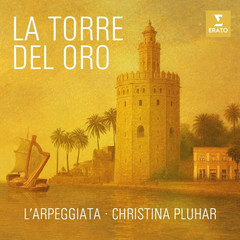
Torre del Oro
Christina Pluhar, L’Arpeggiata- Guayabo Zarandeao
- Cumaná 500 años
- La Diablera (Zamba)
- Yo vengo regando flores
- Que me entierren en un Arpa
- La Sirena
- La Martiniana
- El Coco
- La Lavandera
- El Gavilán
- Fandango
- Claros y frescos rios
- La Petenera
- La mañana de Sant Juan
- El Indio
- Se me llaman
- Pajarito en Sol
- Tonada de Luna Llena
Named after the twelve-sided ‘golden’ tower that dominates the River Guadilquivir in Seville, La Torre del Oro, is the latest album from Christina Pluhar’s ensemble L’Arpeggiata. Tracing and mixing the musical cross-currents that run between Spain and Central and South America – Mexico, Venezuela, Argentina and Chile – it takes the 1500s as the starting point for a captivating journey that reaches the modern day.
The album encompasses both the work of composers and examples of folk music – which in South America frequently uses instruments ‘imported’ from Spain during the country’s so-called Golden Age. This spanned the Renaissance and Baroque eras, when the Torre del Oro became the emblem of Seville as the home port for galleons plying the routes to South America. The city – which first rose to prominence in Roman times and became a major centre of Al-Andalus in the Middle Ages, when its Almohad governor built the riverside tower – remained a significant cultural melting pot.
For La Torre del Oro singers Céline Scheen, Luciana Mancini and Vincenzo Capezzuto join the 13 instrumentalists of L’Arpeggiata, led by Christina Pluhar on the theorbo. Among the other instruments to be heard are baroque guitar and harp, Venezuelan cuatro (a guitar with just four strings) and harp, cornetto, harpsichord, accordion and maracas.
Forming a thread through the album are pieces by the innovative Spanish composer Alonso Mudarra (1510-1580), interwoven with examples of the jácara, fandango, folía, canario, and ciaccona – from both Spain and Central and South America – and the Venezuelan joropo and pájarillo.
The other Spanish composers represented on La Torre del Oro are: Diego Pisador (c.1509-c.1557), notable, like Mudarra, for writing for the vihuela, an instrument characteristic of Spain in the 15th and 16th centuries – it looks like a guitar, but is tuned like a lute; Lucas Ruiz de Ribayas (1626-c.1677), who produced works for harp, lute and guitar, and Santiago de Murcia (1673-1739), whose guitar music achieved currency in South America. Christina Pluhar sees Murcia’s Fandango (Track 11) as a pivotal work on the album, linking Spanish art music to South American oral traditions. The composers from South America – all active in the 20th or 21st century, or both – are Reynaldo Armas, Simón Díaz, Ignacio « Indio » Figueredo and Agustín Rivas (all from Venezuela), Hilda Herrera (Argentina), and Violeta Para (Chile), a pioneer in the 1960s of the nueva canción chilena, a genre combining elements of folk music with social and political activism.