
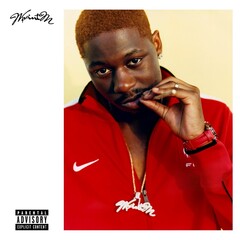
WpointM
Tiakola- Les misérables
- Sauvage
- Mode de vie
- Mélo Décalé
- Bottega (feat. Kuluna, TVLM, Nooche)
- Juda
- Best (feat. Rema)
- Cœur de Pirate
- Sans toi
- WpointM (feat. Niro)
- Tray OG (feat. Bné)
- Caméléon
- La Vie D’un Homme (feat. Zaïko Langa Langa)
- AF1 Nouvo
- Jet Lag (feat. Jorja Smith)
- La Nocture (feat. Theodora)
- Mission
Four years after Mélo—the album that defined a new generation in French music - superstar Tiakola returns with an album of global ambition.
Tiakola’s second bears his initials WpointM (William Mundala) and features Rema, Jorja Smith, Theodora, Zaïko Langa Langa, CNN on a culture shifting record, weaving afrocentric influences like coupé-décalé and rumba, with social and political commentary from Tiakola rapping and singing in multiple voices and modes. WpointM is the new era of the African dream, the era of the “nouvo Africans”: a new Afro-diasporic generation that knows its history and wants to honour it.
First discovered as a member of group 4Keus, Tiakola achieved his nationwide breakthrough while still a teenager. The success of “O’Kartier c’est la Hess” introduced him to the national stage. Since then, the young prodigy from La Courneuve in the Paris banlieue has become one of the most important artists of his generation: a diamond-certified album with Mélo; double platinum with La Mélo est GangX, his collaboration with Gazo; triple platinum with BDLM Vol.1; 22 diamond-certified singles; two sold-out shows at the Accor Arena; eight Flammes awards (the French BETs); and an influence that extends far beyond music.
It has been a meteoric rise, but behind that success there have also been separations, responsibilities, bereavements and periods of profound questioning. Tiakola returns with a clearer perspective on his journey and the world around him. Great artists find great revelations. He approaches this new chapter with a stronger sense of purpose, determined to reveal another side of himself: that of a visionary auteur who has become a leader, entrepreneur, songwriter and producer, but also capable of showing vulnerability, conviction and defiance.
The youngest of eight children, William Mundala—aka Tiako la Mélo—grew up between La Courneuve and the cultural heritage of his Congolese family. Music was everywhere at home: from gospel and Congolese rumba to cassettes of Ivorian music, alongside French and American rap and 2000s R&B. This cultural and musical richness shaped his artistic identity and nurtured the singular sensitivity that would become his signature: la mélo (“the melody”).
The release of Mélo in 2022 marked a major step forward in Tiakola’s solo career. Met with critical acclaim and certified diamond, it became the most-streamed album on Spotify France in 2023, with France the second biggest streaming market for hip hop after the USA. The record established Tiakola as one of the leading figures in mainstream French music. More than a commercial success, Mélo helped popularise a new melodic sound and genre of which he is now the driving force.
This recognition has also brought numerous accolades. Nominated at the Victoires de la Musique (French Brit Awards), Tiakola has made his greatest mark at Les Flammes (French BETs), quickly becoming one of the ceremony’s defining figures. With eight Flammes to his name, he is now one of the most celebrated artists of his generation.
In 2024, he entered a new stage of his career by founding his own label, M3lo World, in partnership with Warner Music and Atlantic Records France. More than simply a business, the label embodies a vision: that of an artist who wants to build something beyond his own career and play an active role in bringing through a new generation.
That desire to create opportunities for others came fully into focus with BDLM Vol.1. The collective project brought together established artists, long-standing friends and emerging talents still largely unknown to the wider public—from SDM, Jolagreen, Genezio, Zed, Prototype and Merveille to Hamza, Ronisia and Rnboi. Certified triple platinum, the mixtape saw Tiakola adopt a rare position: that of an artist using his status to open doors and forge connections. It was a forward-thinking initiative in an industry often defined by individualism.
WpointM represents a turning point for the prince of la mélo: a more personal and socially engaged artistic statement, already evident in its first releases. On “Ronnie Kray”, featuring Landy, Tiakola sparked widespread discussion with a video featuring a French flag emblazoned with “93”. “93” or Neuf-Trois is a reference to the official administrative number of the Seine-Saint-Denis department, north east of central Paris.
It was a symbol of an identity proudly made in the French banlieues, and of his determination to tell his story according to his own rules and codes.
A month later, “Savage” confirmed this new direction: an even more uncompromising track on which the artist proudly asserts his roots, looks back on his journey and recounts the reality that shaped him—the reality of a young man who has grown bigger than his dreams. As Tiakola himself puts it, he wanted to “reach the neighbourhood; instead, he reached the world.” It was his destiny.
“Savage” was also the first track recorded for WpointM. It sets out the album’s tone and intentions: “Mokonzi Azali”—the boss has arrived in Lingala.
That same energy runs through “Mélo Décalé”, the summer 2026 anthem, which pays tribute to the legends of coupé-décalé while issuing a powerful call for Afro-Francophone music videos to be monetised on YouTube.
With WpointM, Tiakola shows that he is becoming increasingly assured in his cultural references, that he continues to fall in love with music and that, through it, he can see the world of tomorrow taking shape.
It is a unifying dream, building a bridge between the children of the diaspora—from Theodora, Jorja Smith, Bné, Niro and La Mano—to artists from the mother continent, including Rema, the legendary group Zaïko Langa Langa and the essential Congolese hype man CNN, all brought together on the project.
WpointM is also a joyful act of mourning. Tiakola, La Courneuve’s little prince—the “good kid from a crazy city”—becomes king, and that new crown inevitably carries a greater weight: the weight of becoming, the weight of responsibility, the weight of setting out towards new worlds, the weight of relationships formed and broken, and the weight of solitude and introspection.
WpointM tells the story of a man crossing a threshold and, over the course of that journey, discovering the world and discovering himself. This return charts the evolution of an artist who, having helped shape the sound of his generation, comes back with renewed energy—more grounded and more determined than ever to continue his mission.